Accessible Boston: A Wheelchair User's Guide To The City
Boston is one of the most walkable cities in America, and most of that walkability can help wheelchair travel, with route-specific limitations: level sidewalks downtown, an elevator-equipped subway, and a harbor front built to modern access standards. This Boston Travel Guide page pulls together what a wheelchair user, a companion, or a trip planner for someone with limited mobility actually needs. Every fare and figure here comes from the MBTA, the National Park Service, or the venues' own published pages.
Short answer
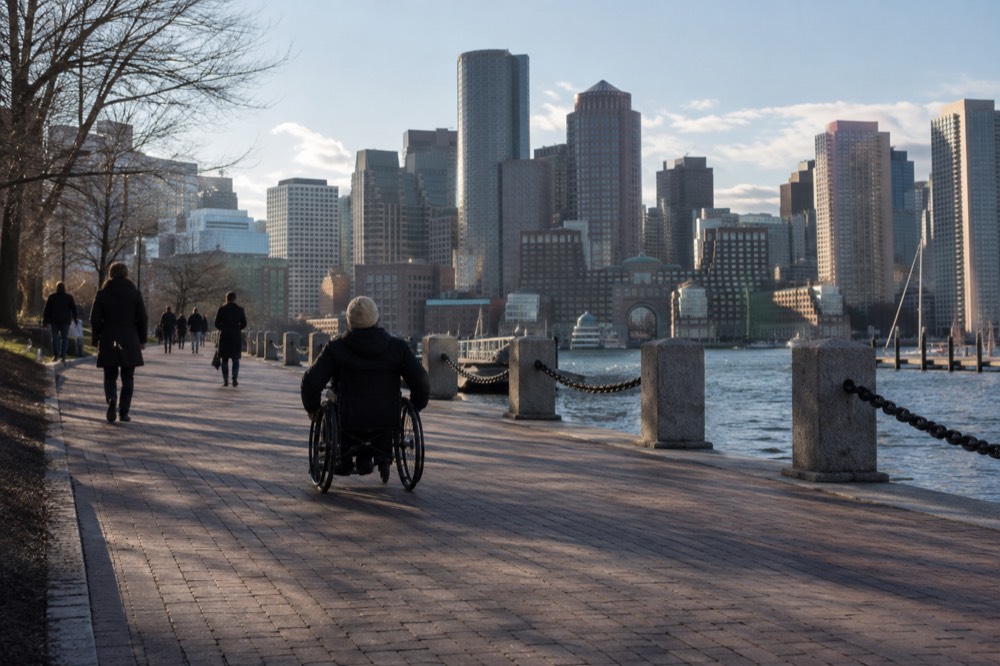
Yes, Boston is broadly wheelchair accessible, and it improves every year. Not every MBTA subway station has accessible platform access, the downtown core is flat and compact, the Harborwalk is a level waterfront path running for miles, and Freedom Trail sites have different admission and access conditions. The main obstacles are cobblestone patches near Faneuil Hall, narrow colonial-era sidewalks in the North End and Beacon Hill, and elevator outages, which the MBTA tracks in real time on its elevator status page.
Boston is one of the most walkable cities in America, and most of that walkability can help wheelchair travel, with route-specific limitations: level sidewalks downtown, an elevator-equipped subway, and a harbor front built to modern access standards. This Boston Travel Guide page pulls together what a wheelchair user, a companion, or a trip planner for someone with limited mobility actually needs. Every fare and figure here comes from the MBTA, the National Park Service, or the venues' own published pages.
Start with the exact room features you need, then choose outings whose boarding, surfaces and restrooms work for your party. Park Plaza lists mobility-accessible room categories; a general hotel listing does not reserve one of those rooms automatically. Check Park Plaza room types and confirm access
Further reading: transfers.
The short version: the city is genuinely usable. Many, but not all, MBTA subway stations are accessible, the Freedom Trail includes uneven surfaces and hills, and each of its 16 sites has separate admission and access conditions. The catches are real but manageable: cobblestones around Faneuil Hall and in parts of the North End, occasional elevator outages on the T, and a few historic buildings where the accessible entrance is around the side. Confirm an accessible route and alternatives for your own mobility needs.
Is Boston Wheelchair Accessible Overall?
Yes, Boston is broadly wheelchair accessible, and it improves every year. Not every MBTA subway station has accessible platform access, the downtown core is flat and compact, the Harborwalk is a level waterfront path running for miles, and Freedom Trail sites have different admission and access conditions. The main obstacles are cobblestone patches near Faneuil Hall, narrow colonial-era sidewalks in the North End and Beacon Hill, and elevator outages, which the MBTA tracks in real time on its elevator status page.
The geography helps. The Shawmut Peninsula that became downtown Boston is flat where it matters, along the waterfront and through Back Bay's gridded streets. The hills that give Beacon Hill and Charlestown their names are the exception, and even there the sidewalks have curb cuts, just steeper ones.
Historic-site access differs substantially. Faneuil Hall has an elevator to the Great Hall, while Old State House involves entrance and interior stairs. Ship boarding depends on the specific vessel and conditions. Read each site’s access information and confirm the features needed for your chair and route; free admission does not establish step-free access.
Further reading: NPS hours-and-fees page for the park.
The honest weak points: winter. Boston's snowfall normal is 49.2 inches, and 58% of it falls in January and February alone, according to NOAA's 1991-2020 climate normals for the Logan Airport station. Sidewalk clearance after a storm is uneven, curb cuts fill with slush, and a winter trip needs a buffer day. The seasonal attractions thin out too: the Swan Boats are closed until April 2027, and the Harbor Islands ferry season ends on 12 October 2026. For timing, see when to plan a Boston trip and the month-by-month Boston weather breakdown.
How Accessible Is The MBTA For Wheelchair Users?
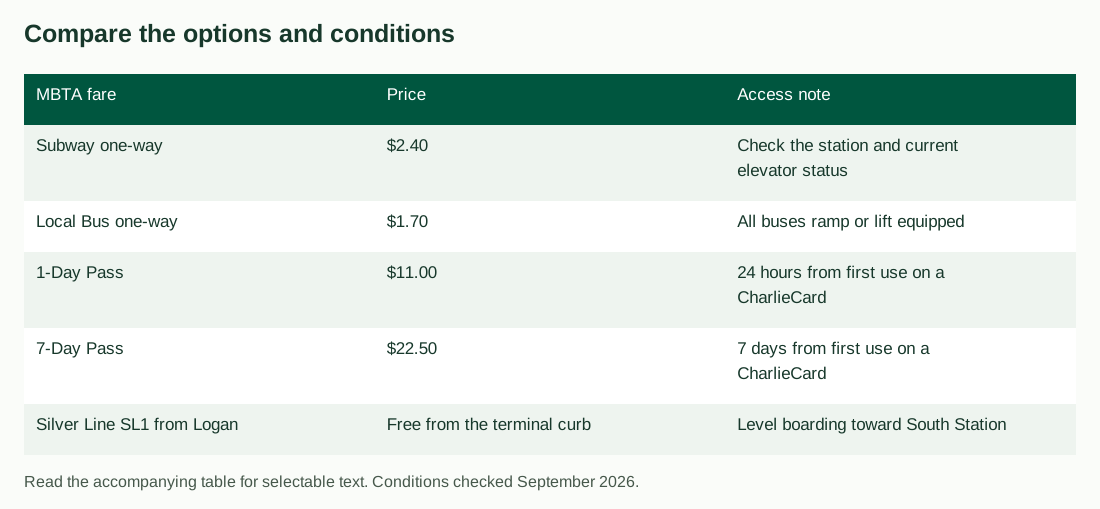
Many, but not all, MBTA subway stations are accessible from street to platform, and all buses have ramps or lifts with priority wheelchair securement areas. A subway ride costs $2.40 and a local bus ride $1.70, and since September 2026 a single payment covers unlimited transfers within a two-hour window, paying only the highest-priced leg. The system's weak point is elevator reliability: outages happen, so check the MBTA's live elevator status page before every trip and know the alternate station.
The fare rules changed on 1 September 2026, and the change is good news for wheelchair users making multi-leg trips. The MBTA's fare pilots page describes the new unlimited-transfer window: ride subway, bus, and ferry within two hours, using the same payment method, and pay only the cost of the highest-priced leg. Previously the cap was two transfers. Contactless Tap to Ride with a card or phone is live on bus, subway, and ferry, which matters because it removes the need to reach a fare machine.
| MBTA fare | Price | Access note |
|---|---|---|
| Subway one-way | $2.40 | Check the station and current elevator status |
| Local Bus one-way | $1.70 | All buses ramp or lift equipped |
| 1-Day Pass | $11.00 | 24 hours from first use on a CharlieCard |
| 7-Day Pass | $22.50 | 7 days from first use on a CharlieCard |
| Silver Line SL1 from Logan | Free from the terminal curb | Level boarding toward South Station |
One detail worth knowing: a 1-Day or 7-Day pass on a CharlieTicket starts at purchase, but the same pass on a CharlieCard starts at first use. For a visitor buying on arrival day and starting tomorrow, the CharlieCard version is most of a day better. The MBTA's fare pages spell this out, and our CharlieCard and fares guide walks through it in full.
The RIDE, the MBTA's paratransit service, covers visitors who qualify under ADA paratransit rules, including eligibility certificates from other US transit systems. It needs advance booking, so it is a backup rather than a spontaneous option. The practical daily strategy for most wheelchair travelers is subway plus bus, with the elevator status page bookmarked.
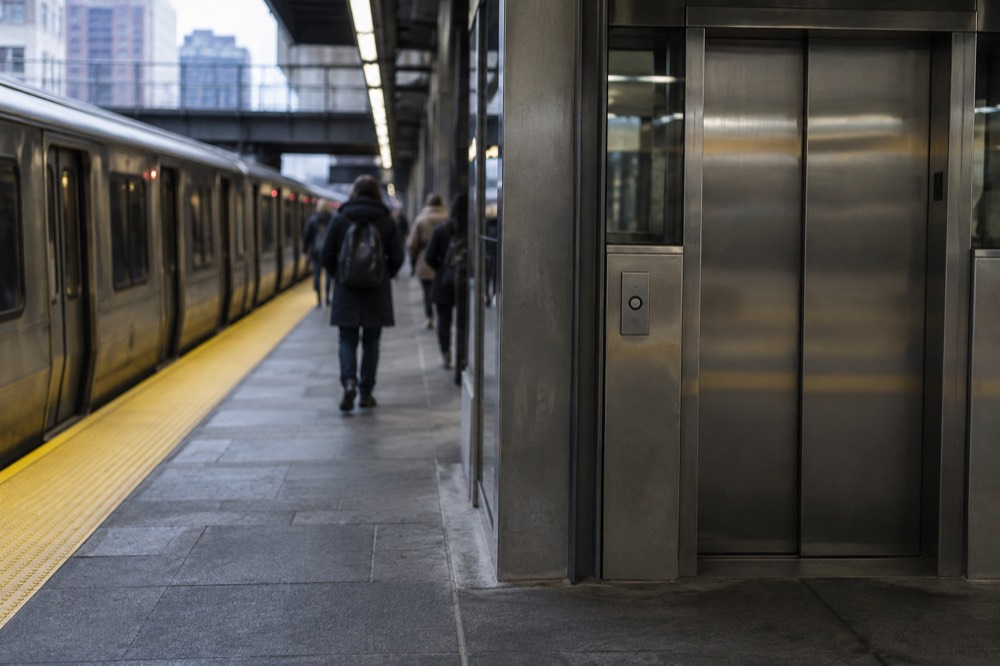
Two current service notes matter for trip planning. Symphony station on the Green Line E branch has been closed since June 2026 for accessibility work, with closure scheduled through spring 2029. And the MBTA has been running weekend diversions through September and October 2026, including full suspensions on segments of the Green, Orange, and Red lines, with free shuttle buses provided. The shuttles are accessible, but they add time. Check service alerts the night before. Our Boston subway map guide and the broader getting around Boston guide cover the network in detail.
Can You Do The Freedom Trail In A Wheelchair?
Yes, the Freedom Trail is largely wheelchair accessible. The 2.5-mile red-lined route runs on public sidewalks that are variable in gradient and surface, and the official sites have individual access and admission conditions. Several sites charge, and a few historic interiors have limited or partial access, but the route itself, from Boston Common to the Bunker Hill Monument, requires route and access planning for the particular chair and traveler.
The Freedom Trail Foundation describes the route as 2.5 miles linking 16 sites across more than 250 years of history. Because it follows city sidewalks rather than a trail surface, the surface is concrete and brick, not dirt. The rough sections are specific and predictable: the cobblestone lanes around Faneuil Hall and Union Oyster House, and the brick paving in parts of the North End, where sidewalks are also narrow. Assess these surfaces for your own chair and mobility; do not assume a companion can safely assist on every gradient.
| Freedom Trail site | Admission | Wheelchair access |
|---|---|---|
| Boston Common | Free | Fully accessible public park |
| Faneuil Hall and Great Hall | Free | Elevator access to the Great Hall |
| Old South Meeting House | Combined admission; check current price | Accessible entrance, per the NPS |
| Old State House | Combined with Old South ticket | Not wheelchair accessible: entrance and interior stairs |
| Paul Revere House | $6.00 adult | Narrow historic rooms, partial access |
| Old North Church | Discovery Pass $10.00 | Ramp entrance on the side |
| USS Constitution | Free | Limited access; confirm tide-dependent top-deck boarding with Navy; lower decks have steep stairs |
| Bunker Hill Monument | Free | Museum accessible; monument climb is stairs |
The National Park Service's hours-and-fees page for Boston National Historical Park is the source for every price above, and it is also the source for the most useful fact on this whole page: admission to the Old State House is $0.00 with an Old South Meeting House ticket, and vice versa. The combined ticket does not make Old State House accessible: its entrance and floors involve stairs. The USS Constitution Museum, separate from the ship, runs on pay-what-you-wish admission rather than a fixed price.
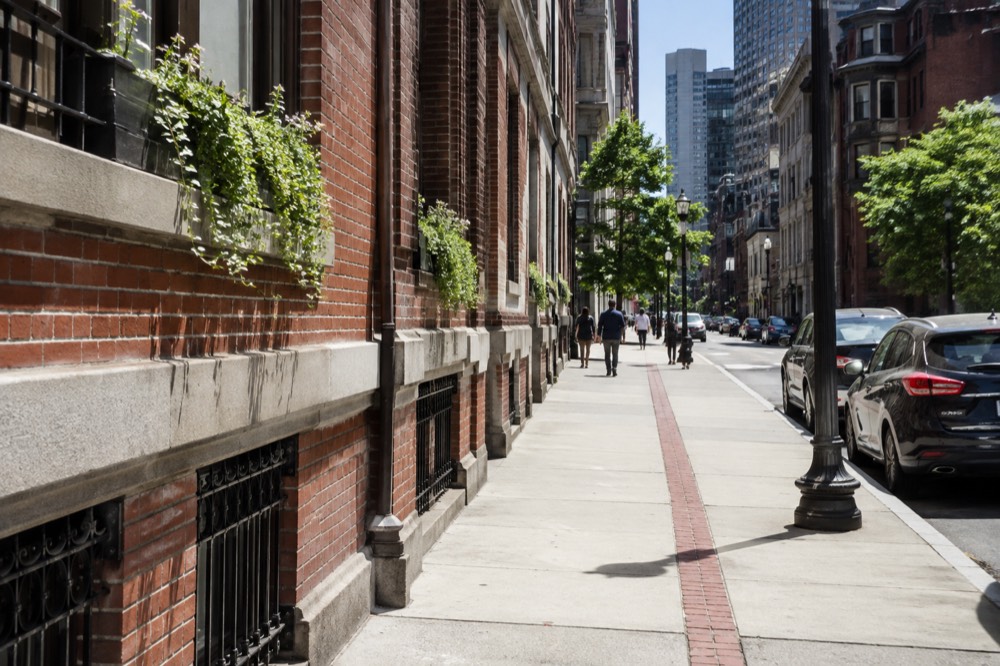
A guide can explain the history, but an ordinary group tour is not a promise of a bespoke accessible route. Confirm surfaces, gradients and every planned entrance before choosing a guided walk. See Freedom Trail tour options for route comparisons.
Which Boston Museums Are Wheelchair Accessible?
Major museums publish access routes and assistance information; confirm the particular galleries, restrooms and any loaner-chair availability. The Museum of Fine Arts charges $30 adult admission, the Museum of Science $33, the New England Aquarium $39.95, and the Isabella Stewart Gardner Museum $25, and each publishes its access details on its own visit page. The one caveat is the Gardner's historic palace interior, which is accessible but tight in places.
The Museum of Fine Arts is the easiest big visit in the city: a flat Huntington Avenue entrance, elevators throughout, and accessible restrooms on multiple floors. Its visit page also lists the $4 ticket exchange fee and the free-admission rules that trip up out-of-state visitors. The MFA's "Open House" free days are for Massachusetts residents only, and the page says plainly that visitors must supply a valid Massachusetts zip code. What a tourist can use is $5 Third Thursdays: pay-what-you-wish admission with a $5 minimum, every third Thursday of the month, in person, day of. The MFA publishes the dates, and 17 September and 15 October 2026 are on its calendar.
The Gardner Museum is the interesting access case. The palace itself has elevators and ramps serving the gallery levels, and the museum's admissions page confirms free entry for everyone 17 and under, plus its standing quirk: anyone named Isabella gets in free. Eight eighteenth-century rooms in the MFA’s Art of the Americas wing reopened on 19 June 2026 with new 18th-century displays for the America 250 anniversary, while other gallery availability still depends on the museum’s current notices.
| Museum | Adult admission | Wheelchair access notes |
|---|---|---|
| Museum of Fine Arts | $30 | Level entry, elevators, loaner chairs |
| Museum of Science | $33 | Accessible; Blue Wing under renovation until late 2026 |
| New England Aquarium | Free for visitors using their own wheelchair or with visual impairment | Obtain the eligible ticket at the Information Desk; borrowing a free loaner chair is a separate service |
| Isabella Stewart Gardner | $25 | Elevators; historic interior, tight in spots |
| ICA Boston | $20 | Modern building, fully accessible |
| View Boston (Prudential) | Check date and ticket type | Elevator access to the deck |
The Museum of Science deserves a planning note. It is open and accessible while it builds the new Bloomberg Public Science Common, targeted to open in late 2026, but three smaller exhibits, the Garden Walk and Insect Zoo, Museum Then and Now, and Behind the Scenes, have closed permanently. The museum's own construction updates page tracks this. The ICA is the opposite of a caveat: a modern Fan Pier building, fully accessible, and free every Thursday night from 5 to 9pm for all visitors, with advance tickets required.
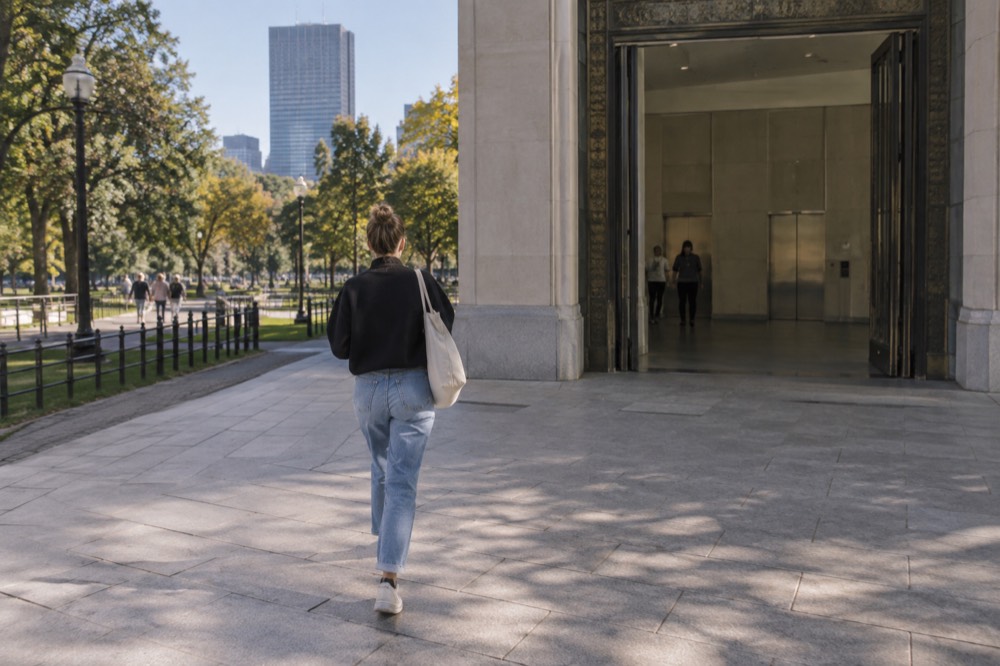
If several museums are on the list, compare the exact paid admissions after any accessibility-related or other eligibility discounts. CityPASS offers four choices from its current participating attractions; it is not necessarily cheaper for a visitor entitled to free entry. Our CityPASS versus Go Boston guide explains the selection differences.
Is The Boston Harborfront Accessible?
Parts of the Harborwalk provide useful paved waterfront routes, but the route has gaps, different surfaces and access conditions. Check the segment and any closures you plan to use. Boat access is a separate question involving the particular vessel, gangway angle, chair dimensions, assistance and restroom; a Long Wharf departure does not guarantee all of those features.
NOAA station 8443970 gives Boston a mean tidal range of about 9.49 feet. The changing water level alters gangway angles, so confirm your dated boarding arrangements with the operator before purchase. A ramp alone is not enough to establish that the entire trip, including the restroom, meets your needs.
Harbor Islands services are seasonal, with island-specific fall calendars through October 12, 2026. Check the actual fare and discuss vessel boarding and the intended island route before booking; fort stairs and uneven paths can limit access even when parts of an island are accessible. Whale-watch vessels have their own access details, covered in the Boston whale watching guide.
Further reading: ferry schedule page.
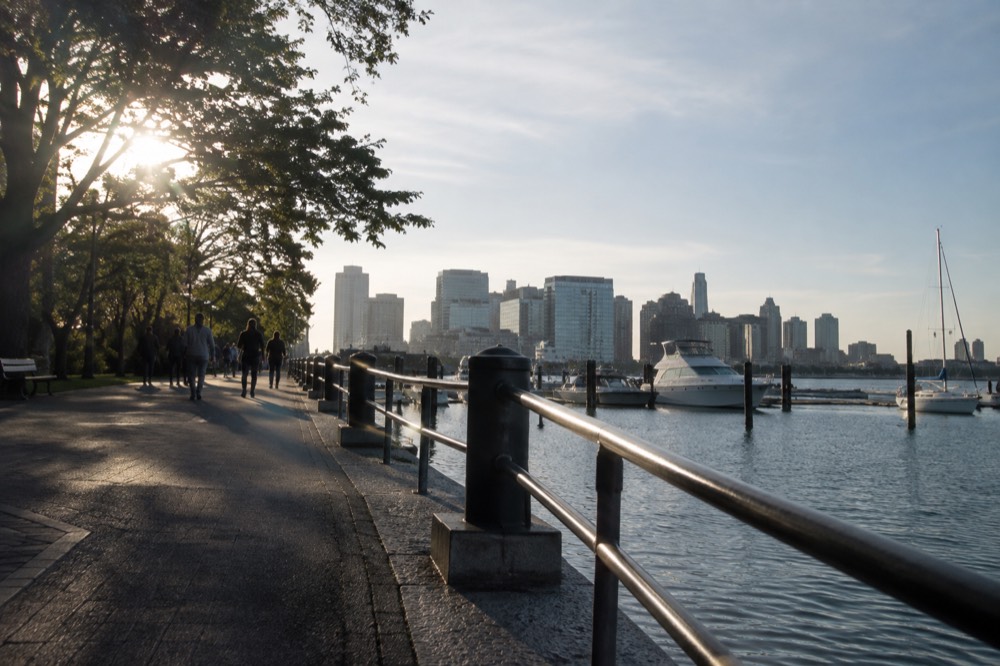
Boat access depends on the vessel, gangway, tide and restroom. The historical harbor cruise lists wheelchair access, but not an accessible restroom. Do not assume that a tall ship or sunset departure has equivalent access; confirm the specific boat and assistance arrangement.
Check boarding and restroom access before paying for a harbor cruise. The one-hour historical cruise lists wheelchair access aboard, but its restrooms are not wheelchair accessible. Confirm the particular vessel and tide-dependent gangway with the operator. Check harbor cruise options and access requirements
Where Should A Wheelchair User Stay In Boston?
Back Bay and the Seaport are the best neighborhoods for a wheelchair user, because both are flat, modern, and dense with accessible hotel rooms, and their transit access differs; Seaport uses Silver Line buses. Downtown and the Financial District work nearly as well. The North End and Beacon Hill are the hardest, with narrow sidewalks, brick and cobblestone surfaces, and older building stock, so check the particular hotel and street approach.
Back Bay's grid is the friendliest street plan in the city: wide sidewalks, consistent curb cuts, and level blocks from the Public Garden to the Fenway. The Seaport is newer still, built to post-ADA code, with wide Harborwalk frontage and elevators everywhere. Both put a wheelchair user within a short roll of the museums and the waterfront. The trade-offs and price tiers of each neighborhood are compared in where to stay in Boston.
| Neighborhood | Surface and terrain | Hotel access | Best for |
|---|---|---|---|
| Back Bay | Flat grid, wide sidewalks | Many modern hotels | First visit, base camp |
| Seaport | New construction, level | Newest accessible stock | Waterfront, ICA, dining |
| Downtown / Financial District | Flat, some cobblestone | Good, central | Freedom Trail start |
| Beacon Hill | Steep, brick, narrow | Limited older stock | Daytime visit only |
| North End | Narrow sidewalks, cobblestone | Very limited | Daytime food visit |
When booking, confirm the exact room category and features with the hotel: doorway clearances, bed height, bathroom layout, shower or tub configuration, and any other requirement specific to you. Hearing-accessible and mobility-accessible rooms meet different needs; neither label automatically supplies every feature. Retain written confirmation that the booked room matches your requirements. For airport logistics, see the Logan Airport guide, Logan to downtown transport options and hotels near Logan.
Looking for an accessible place to stay that fits your needs? Book a hotel room here.
Want a central base with specific mobility room categories? Explore Park Plaza’s rooms, then confirm the exact bed setup, bathroom and shower features your party needs. A hearing-accessible room serves different needs; the booking must explicitly match your requirements. Check Park Plaza room types and confirm access
How Accessible Is Getting From Logan Airport?
Logan Airport is strongly accessible, and the cheapest route into downtown is also the most accessible one: the Silver Line SL1 bus is free leaving the airport, boarding at the terminal curb with a ramp, and runs directly to South Station, where elevators connect to the Red Line without any fare collected. Massport's own page states this free leg plainly. The Blue Line connection via the free on-airport shuttle is the level alternative, and Logan Express serves Back Bay, Braintree, Framingham, and Woburn.
Read the free direction carefully, because guides get it backwards. Massport's to-from-Logan page says the SL1 provides free service between South Station and all airport terminals, from the terminal curb. The free leg is the one leaving the airport: board at the curb, no fare is collected, and the bus runs into South Station where you join the subway network. Going back toward Logan later, you pay the ordinary $2.40 subway fare from inside the paid system. Practical effect: arriving in Boston from Logan by transit can cost nothing.
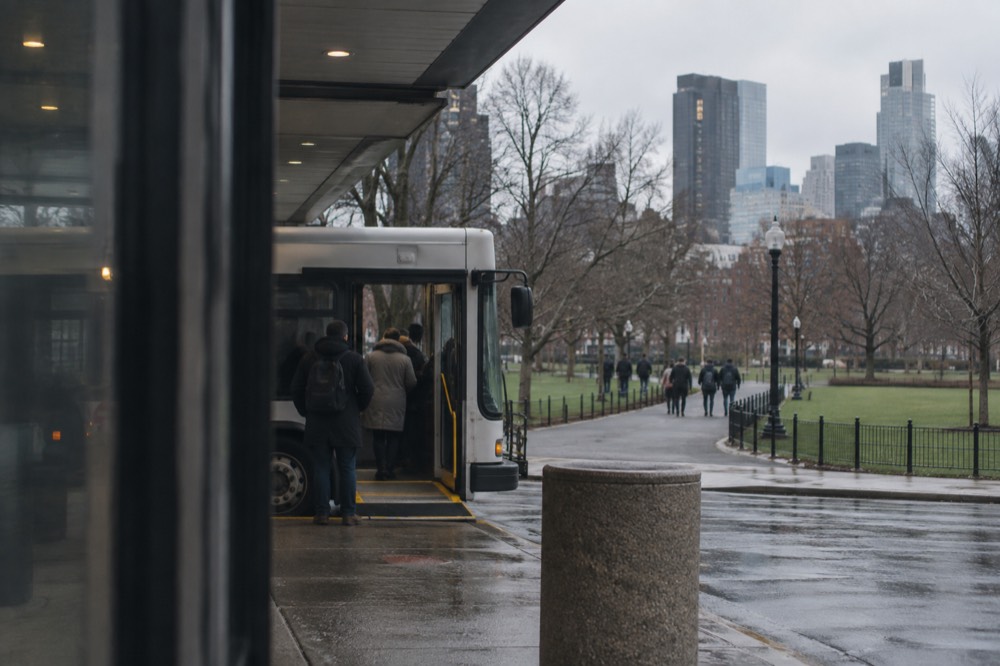
Massport’s free terminal shuttle connects with Airport station on the Blue Line. Confirm the exact station route and elevator status; Bowdoin is not an accessible downtown destination. Construction can change curb access and walking routes, so check current Massport notices rather than treating an undated bridge closure as a 2026 event. Logan Express routes and boarding arrangements have separate access information. The Boston parking guide and Logan parking options cover driving alternatives.
Further reading: roadway and construction updates page.
What Accessible Tours And Food Options Exist In Boston?
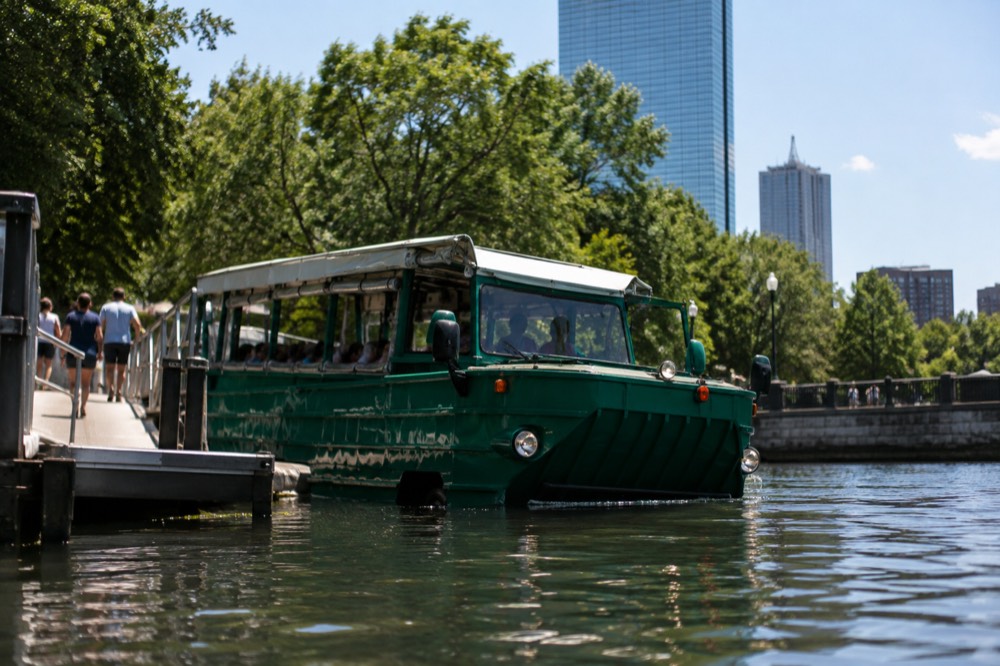
Boston Duck Tours offers wheelchair lifts at the Prudential Center, Museum of Science and Aquarium departure locations. Guests remaining in a wheelchair must call 617-450-0068 to arrange space. Other tours have their own vehicle, surface and restroom limitations; confirm the exact departure before booking.
Boston Duck Tours is one operator with three departure locations. The tour combines city roads and the Charles River in about 80 minutes. An accessible vehicle or a folding-chair storage policy on another tour should not be treated as equivalent to confirmed onboard wheelchair accommodation. Check the chosen seller’s cancellation terms.
Food outings need venue-by-venue checks. The North End has narrow sidewalks, brick and uneven surfaces, while restaurant entrances and restrooms vary. Ask the operator about the actual route and stops; do not assume a tour can reroute on request. The five-hour food-and-history walk adds distance and Beacon Hill gradients.
For a sit-down classic, the best lobster rolls in Boston are scattered from the Seaport to Cambridge, and most of the top rooms are modern and level. Weekend planning, including accessible events and seasonal closures, is in things to do in Boston this weekend, and the full attraction index is on the things to do in Boston page.
Check wheelchair-space arrangements before buying the Duck Tour. Accessible vehicles operate from all three locations, but guests remaining in their chairs must call 617-450-0068 to arrange capacity. Confirm the chosen departure; lift availability is not an automatic online reservation. Check Duck Tour options; arrange access by phone
Common Questions About Wheelchair Accessible Boston
is boston wheelchair accessible
Yes. Not every MBTA subway station is accessible, all buses have ramps or lifts, the downtown core and Harborwalk are flat and level, and Freedom Trail access varies by site. The obstacles are specific: cobblestones near Faneuil Hall and in the North End, narrow sidewalks in Beacon Hill, and occasional elevator outages, so bookmark the MBTA's live elevator status page.
can you do the freedom trail in a wheelchair
Yes, the 2.5-mile route follows public sidewalks that are variable in surface and gradient, from Boston Common to the Bunker Hill Monument. Individual sites have different admission rules, and the National Park Service publishes each site's access details. Expect cobblestone patches near Faneuil Hall and in the North End, and a couple of historic interiors with partial access.
are boston museums wheelchair accessible
Major museums publish their access features, but confirm the exact route, restroom and any assistance or loaner-chair need. At the Aquarium, visitors using their own wheelchair and visitors with visual impairments can obtain free admission at the Information Desk. Free loaner wheelchairs for ticketed guests are a separate first-come service.
is the mbta accessible for wheelchairs
Yes. Not every subway station is accessible, every bus has a ramp or lift, and the RIDE paratransit service covers qualifying visitors with advance booking. Since 1 September 2026, one payment covers unlimited transfers within two hours, paying only the highest-priced leg. Check the elevator status page before each trip, since outages are the system's weak point.
is the silver line from logan airport free and accessible
Yes. The Silver Line SL1 is free leaving the airport, boarding at the terminal curb with a ramp, and runs to South Station where elevators connect to the Red Line. Massport's own page confirms the free leg. The return trip toward Logan costs the ordinary $2.40 subway fare.
where is the best place to stay in boston for wheelchair users
Back Bay and the Seaport. Confirm the specific hotel room and route; Seaport’s Silver Line is a bus service. Downtown and the Financial District are close behind. Beacon Hill and the North End are the hardest neighborhoods for surfaces and older buildings, so assess the exact property and approach rather than ruling out every hotel.
Confirm The Access Detail Before Booking
These options do not match your choice. Adjust the selection or reset to explore the starting recommendation.
Compare Your Confirmed Room And Outing Totals
Reader-entered estimates in USD, not live quotes. Use the same dates and travelers for both options. Include all relevant tickets, rooms, taxes, mandatory fees and transport for the entire trip once in each total. Do not add a transfer twice if your rate already includes it.
Park Plaza: Confirm The Exact Accessible Room
Hilton Boston Park Plaza lists mobility- and hearing-accessible room categories, including some with roll-in showers. Confirm the exact room, bed, bathroom and shower features in writing before booking. A general hotel result does not automatically reserve an accessible room. Compare the full stay total and cancellation terms.
A starting option to explore. Choose dates, travelers and the exact booking option with the provider; availability and eligibility are confirmed there.
Check Park Plaza room types and confirm access