CharlieCard And MBTA Fares
The MBTA's fare system changed on 1 September 2026, and most guides still describe the old rules. Here is what a CharlieCard actually costs, how the new two-hour transfer window works, and when a pass beats paying per ride.
Short answer
A subway ride costs $2.40 and a local bus $1.70. Since 1 September 2026 you get unlimited transfers within two hours paying only the highest leg. A 7-Day pass is $22.50 and starts at first tap on a CharlieCard.
Boston's subway is one of the oldest in the country, and its fare system is now one of the more confusing, because the rules changed on 1 September 2026 and most travel advice still describes the old ones. The Boston Travel Guide desk has gone through the MBTA's own fare pages line by line, and this guide lays out what a ride costs, what the CharlieCard does, and where the traps are. The single biggest one: a pass you load onto a CharlieCard behaves differently from the same pass on a paper CharlieTicket, and the difference is most of a day.
What Is A CharlieCard And Do You Need One?
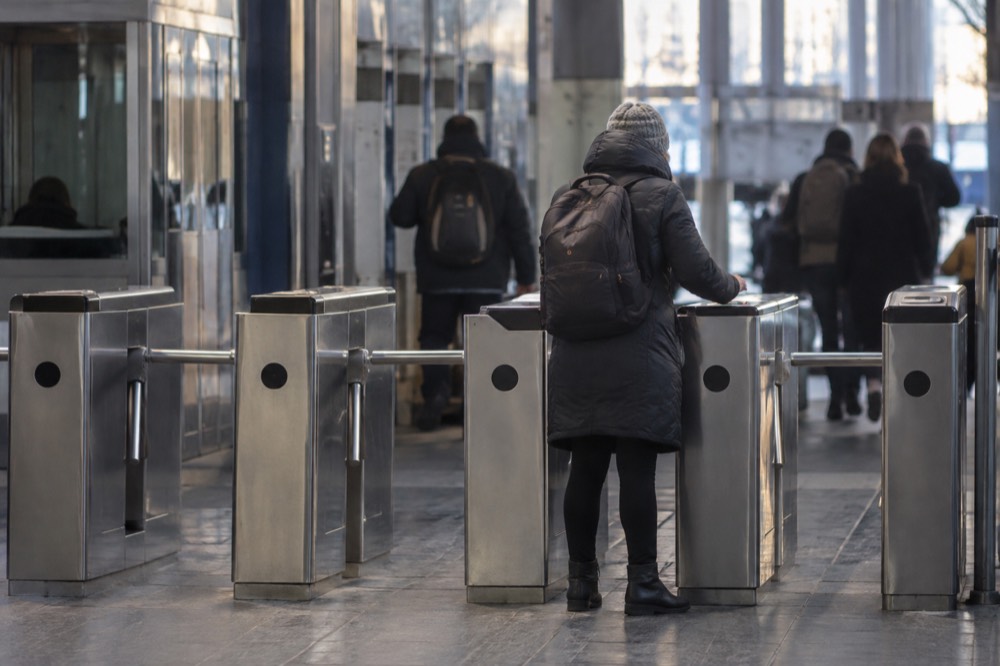
A CharlieCard is the MBTA's reusable plastic fare card. It holds stored cash value or a 1-Day, 7-Day or monthly pass, and you tap it at the fare gate or bus front door. You do not strictly need one, because the MBTA also sells paper CharlieTickets and now accepts contactless Tap to Ride with a credit card, phone or watch, but the CharlieCard is the medium most visitors will end up holding, and the rules attached to it differ from the paper ticket in one way that matters.
The card itself is free from a fare machine or an MBTA employee; you pay money onto it. Stored value works per ride: tap at the gate, the fare is deducted, ride the subway or bus. The MBTA's fare pages describe both media, the plastic card and the paper ticket, and treat them as interchangeable right up until you buy a pass, at which point they are not.
If you are only in town for a day or two and carrying a contactless credit card, Tap to Ride is live on bus, subway and ferry, per the MBTA's own Tap to Ride page. The one catch, and it is a real one, is that transfers under the new rules require the same form of payment on every leg. Tap the same card or the same phone every time, or the two-hour window does not apply.
Where the card earns its place in a pocket is durability and reloadability. A paper ticket can be bent, soaked by a sudden rain squall off the harbor, or lost in a jacket you packed away, and transfer eligibility depends on the ticket, payment method and modes. A CharlieCard survives the week, reloads at any machine, and carries the pass rules most favorable to a visitor. Choose the payment method and pass that fit your actual journeys.
For a wider picture of the network itself, the getting around Boston guide covers the lines, and the Boston subway map explained page untangles the color-coded branches.
What Do MBTA Fares Cost In Boston?
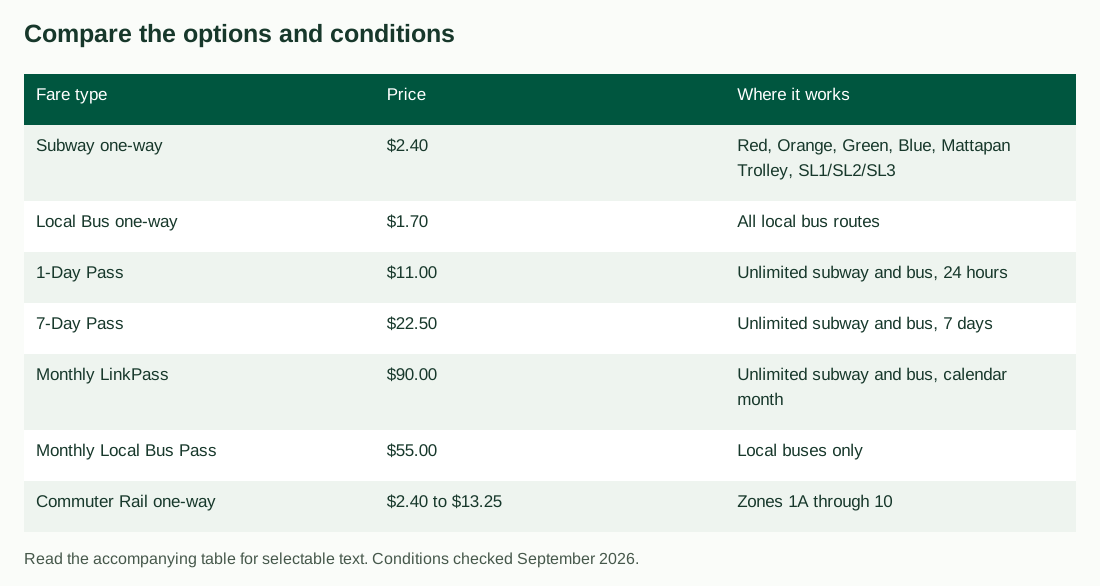
A one-way subway ride costs $2.40, a local bus ride $1.70, and those fares apply on the Red, Orange, Green and Blue lines, the Mattapan Trolley and Silver Line routes SL1, SL2 and SL3. A 1-Day Pass costs $11.00, a 7-Day Pass $22.50, a monthly LinkPass $90.00 and a monthly local bus pass $55.00. Commuter Rail one-way fares run from $2.40 in Zone 1A up to $13.25 in Zone 10.
The MBTA publishes the full table on its fares page, and the figures above come straight from it. Here is the version a visitor actually plans from:
| Fare type | Price | Where it works |
|---|---|---|
| Subway one-way | $2.40 | Red, Orange, Green, Blue, Mattapan Trolley, SL1/SL2/SL3 |
| Local Bus one-way | $1.70 | All local bus routes |
| 1-Day Pass | $11.00 | Unlimited subway and bus, 24 hours |
| 7-Day Pass | $22.50 | Unlimited subway and bus, 7 days |
| Monthly LinkPass | $90.00 | Unlimited subway and bus, calendar month |
| Monthly Local Bus Pass | $55.00 | Local buses only |
| Commuter Rail one-way | $2.40 to $13.25 | Zones 1A through 10 |
The quick arithmetic: a 1-Day Pass pays off once you take five subway rides in a day, and a 7-Day Pass pays off at ten rides across the week. Count separately charged rides, excluding qualifying free transfers. Walking nearby stops can keep paid-ride totals below those thresholds. The things to do in Boston page gives a sense of how spread the headline attractions really are.
One habit worth building before you ride: check the fare display when you tap. The gate or the bus reader shows what was deducted, and under the new transfer rules it will show $0.00 on any leg cheaper than the highest one already paid inside the two-hour window. Riders who never look assume they were charged twice and end up at the fare machine buying a pass they did not need.
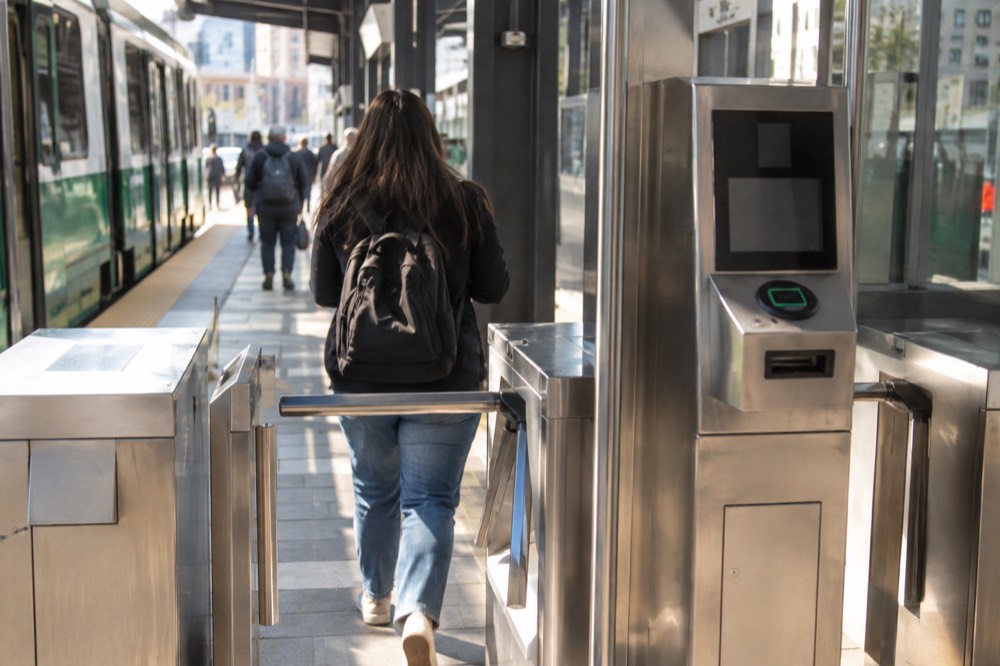
Check refund rules and the selected medium before buying a pass. A CharlieTicket pass begins at purchase, while the eligible CharlieCard product begins at first use; buying a CharlieCard pass in advance does not itself start that first-use clock.
When Does A 7-Day Pass Start, CharlieCard Or CharlieTicket?
The same pass starts at a different moment depending on what carries it. A 1-Day or 7-Day pass loaded on a CharlieTicket is valid from the date and time of purchase, while the identical pass on a CharlieCard is valid from its first use. For a visitor who buys on arrival evening and starts sightseeing the next morning, that gap is most of a day of validity, and it is the single most common way tourists lose pass value without noticing.
The MBTA states this plainly on its subway fares page, and it is worth reading twice because the wording is easy to skim past. Practical version: if you buy at a machine on a CharlieTicket at 8pm Tuesday, your 7-Day clock starts Tuesday night. Load the same pass on a CharlieCard and the clock starts at your first tap, so you can buy Tuesday and start Sunday with nothing lost.
| CharlieCard (plastic) | CharlieTicket (paper) | |
|---|---|---|
| Holds stored value | Yes | Yes |
| Holds 1-Day / 7-Day / monthly pass | Yes | Yes |
| 1-Day / 7-Day validity starts | At first use | At purchase |
| Transfers with stored value | Eligible modes, same payment method | Check current route/payment rules |
| Refunds on passes | No | No |
Transfer rules depend on the actual medium and modes. Do not assume every paper ticket has the same transfer entitlement, or confuse a stored-value ticket with a pass. Consult the current MBTA transfer table for your route; use one eligible payment method consistently across the journey.
How Do Transfers Work After The September 2026 Change?
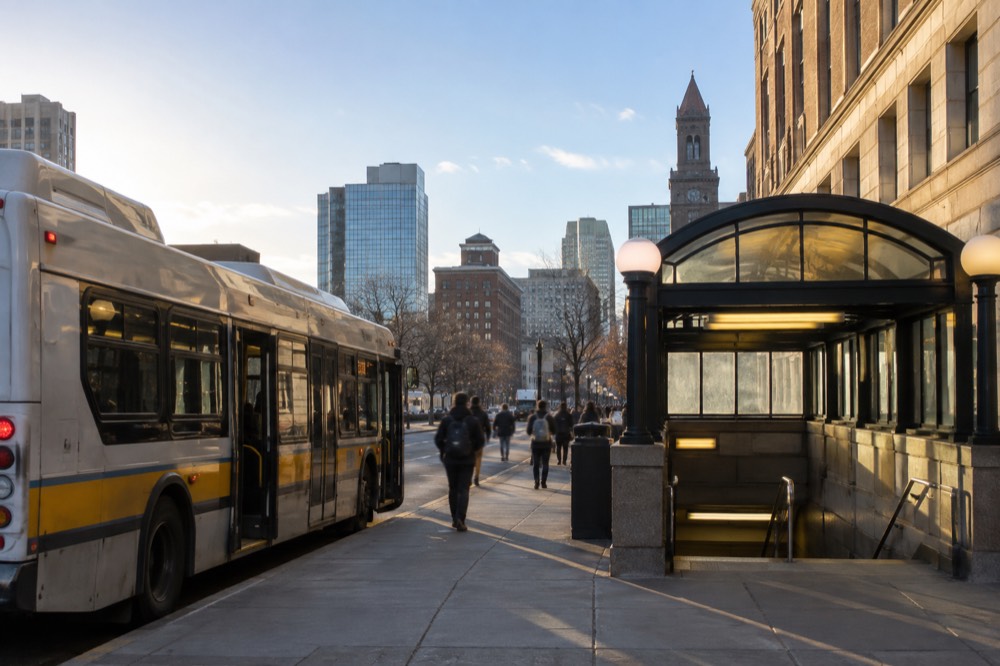
Since 1 September 2026, riders can make an unlimited number of transfers between subway, bus and ferry within a two-hour window and pay only the cost of the highest-priced leg, provided the same form of payment is used on every leg. Before the pilot, transfers were capped at two with further restrictions. Express Bus fares also dropped to the local bus fare of $1.70 as part of the same pilot, and Express Bus passes are no longer sold.
The MBTA documents the pilots on its fall fare pilots page. For a tourist, the practical effect is that a complicated cross-town journey, subway then bus then subway again, costs the price of one subway ride as long as every tap is the same card, phone or CharlieCard. Break the chain by paying cash for one leg and you pay full fare on that leg.
Two caveats the MBTA itself flags. Single-ride Commuter Rail and ferry tickets generally do not include free transfers, so a Zone 1A train ticket does not become a free subway ride downtown. And certain monthly Commuter Rail passes printed on a CharlieTicket do include transfers; the details are on the subway fares page. If your plans lean toward the commuter rail, the Boston commuter rail guide covers the zones and the day-trip math.
A worked example shows how much the window is worth. Suppose a morning runs Green Line from Kenmore to Park Street, then the Red Line to Harvard, then a bus back across the river, all inside two hours with one contactless card. The in-station Green-to-Red change does not itself require a second fare. Under the pilot it is one $2.40 charge, because the subway legs are the highest-priced and everything else rides free inside the window.
Is The Silver Line Really Free From Logan Airport?
Yes, in one direction. The MBTA Silver Line SL1 provides free service between South Station and all airport terminals, boarding at the terminal curb with no fare collected, and because SL1 runs into South Station you reach the subway network without paying. Going the other way, toward Logan, you are inside the paid system and pay the ordinary $2.40 subway fare. Massport states the free leg in its own words on its airport transport page.
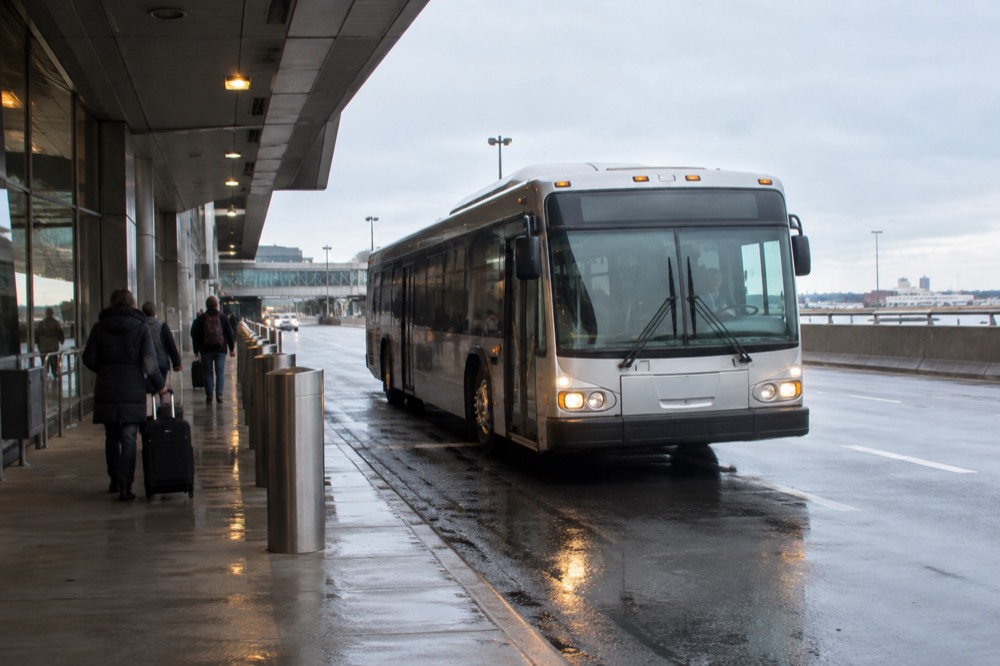
The inbound SL1 is free from the terminals, and the in-station Red Line transfer at South Station is also free. You do not make a paid tap merely to continue on Red. The Logan-to-downtown guide compares other routes, and the Logan guide covers current airport planning.
Massport runs free airport shuttles to Airport station on the Blue Line, Economy Parking and the Rental Car Center. The Blue Line fare itself is separate. Logan Express serves Back Bay, Braintree, Framingham, Woburn and Danvers; consult the airport transport page for the current route and fare.
Which MBTA Pass Should A Tourist Actually Buy?
Choose by separately charged journeys, not the number of nights in Boston. At $2.40 per subway fare, the $11 day pass first saves money at five paid fares, and the $22.50 seven-day pass at ten. Free transfers reduce your paid-fare count. Ordinary contactless payment is not automatically a seven-day pass or fare cap.
Divide $22.50 by $2.40 to get 9.375 fares: ten separate subway fares cost $24. A two-day visitor might exceed that threshold while a seven-day visitor who mostly walks might not. Compare your actual journeys, including eligible free transfers and any other transport modes.
| Your journeys | Product to compare |
|---|---|
| Few separately charged rides | Stored value or consistent contactless payment |
| Five or more $2.40 fares in one day | $11 day pass |
| Ten or more $2.40 fares within seven days | $22.50 seven-day pass |
| Cambridge or Somerville subway travel | Same standard subway fares |
| Commuter Rail / ferry plans | Exact route, pass medium and included modes |
One boundary worth knowing: Cambridge and Somerville are separate cities, while Brookline is a separate town, not Boston neighborhoods, but the subway does not care. The same $2.40 and the same passes cover Harvard Square and Davis Square exactly as they cover Park Street.
If sightseeing rather than transport is the budget line you are weighing, the attraction-pass comparison lives on the CityPASS versus Go Boston page, and the multi-attraction Boston Pass is one of the instruments it weighs.
What MBTA Closures Should You Plan Around?
Symphony station on the Green Line E branch has been closed since 6 June 2026 for accessibility work, with closure scheduled through spring 2029, so anyone staying near the Symphony Hall end of Back Bay should plan on walking or using the Orange Line instead. Beyond that, the MBTA is running rolling weekend diversions on the tourist lines through September and into October 2026, including full suspensions of central Green Line segments and Orange and Red Line segments on specific weekends, with free shuttle buses provided.
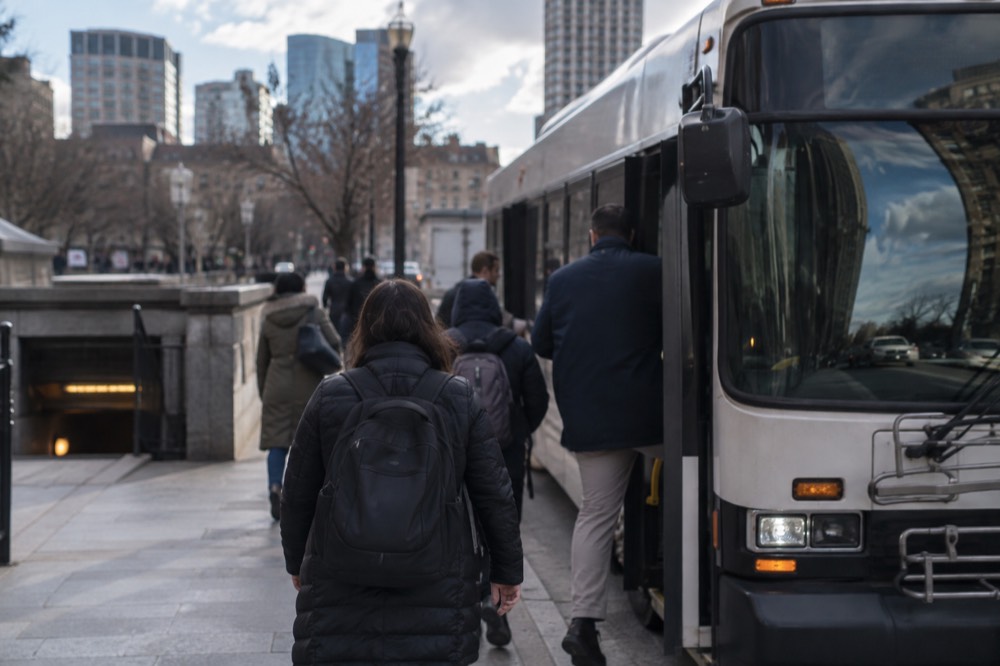
The closures are scheduled maintenance, not a crisis, but they land on weekends, which is exactly when visitors travel. The MBTA posts each weekend's diversions on its site, and the shuttle buses are free, so a closure rarely costs money, only time. Check the MBTA's service alerts for your dates rather than trusting any static schedule printed anywhere, including here.
The pattern that matters for planning: downtown Boston, the Freedom Trail, the North End and Back Bay are all walkable clusters. On a weekend when one line is down, the answer is usually to walk the short leg and ride the long one.
Can You Skip The T Entirely And Still See Boston?
Large parts of central Boston are walkable enough that many visitors ride the subway only twice a day, in and out, and walk everything between, which is why per-ride payment beats a pass more often than fare-table arithmetic suggests. The Freedom Trail alone is a 2.5-mile red-lined walking route linking 16 historic sites, with free public outdoor stops and separately ticketed interiors, so the cheapest Boston day is a walking day that costs nothing but shoe leather.

The Freedom Trail Foundation describes a free 2.5-mile public route. Interior admissions vary: Old State House and Old South have a combined ticket, while Paul Revere House, Old North and King’s Chapel church have separate arrangements. USS Constitution and Bunker Hill are free when open. The guided-walk page describes an optional downtown-to-North-End tour; it does not include the whole Charlestown route or paid interiors.
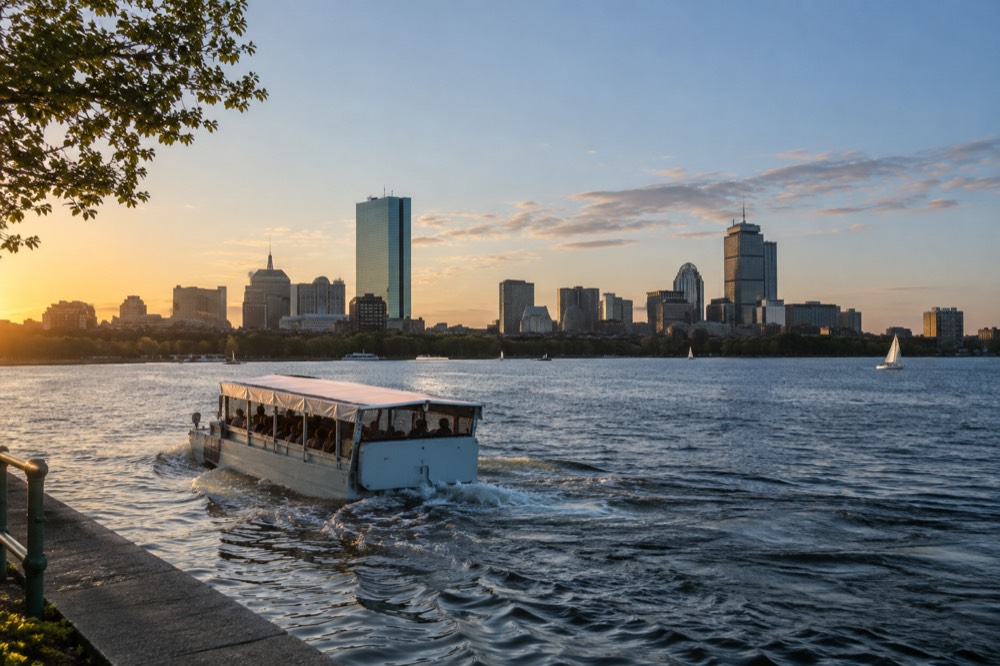
A sightseeing vehicle is a different purchase from public transport: a Duck Tour runs a fixed street-and-river loop rather than taking you between arbitrary stops. The Duck Tours guide explains the seasonal format; its departure listing and tour guide describe the actual ticket. It is not a substitute for a CharlieCard or an MBTA pass.
Common Questions About CharlieCard And MBTA Fares
how much is the subway in boston
A one-way subway ride costs $2.40 on the Red, Orange, Green and Blue lines, the Mattapan Trolley and Silver Line routes SL1, SL2 and SL3, per the MBTA's fare page. A local bus ride is $1.70.
is the charliecard free
The plastic card itself is free from a fare machine or an MBTA employee; you load money or a pass onto it. There is no charge for the card, only for the value or pass you add.
should i buy a 7-day charliecard pass
Compare your actual paid journeys. Ten separately charged $2.40 subway fares cost $24, more than the $22.50 pass. Free transfers do not count as additional paid fares, and other modes or reduced fares change the calculation. Trip length alone does not decide.
do mbta transfers cost extra
Since 1 September 2026, transfers between subway, bus and ferry are unlimited within a two-hour window and you pay only the highest-priced leg, as long as every leg uses the same form of payment. Check payment- and mode-specific transfer rules; cash payments do not qualify for the electronic transfer window.
is the silver line free from logan airport
Yes, leaving the airport. The Silver Line SL1 is free from the terminal curb to South Station, per Massport, so arriving in Boston by public transport can cost nothing. Heading toward Logan you pay the ordinary $2.40 subway fare.
can i use a credit card on the mbta
Yes. Contactless Tap to Ride with a credit or debit card, phone or watch is live on bus, subway and ferry. Use the same card or device on every leg of a journey to keep the two-hour transfer window active.