Best Clam Chowder In Boston
Boston's most famous food is a soup, and the city takes it seriously enough that the New England version, cream, clams, potatoes, and salt pork, has been the standing answer to Manhattan's tomato-based rival for well over a century. The state legislature has even been the subject of a long-running local joke about outlawing the tomato version, a story the Boston Globe and others have retold for decades. This page covers where the best bowls actually are, what they cost, which neighborhoods reward a chowder crawl, and how a guided food walk can save you the guesswork.
Short answer
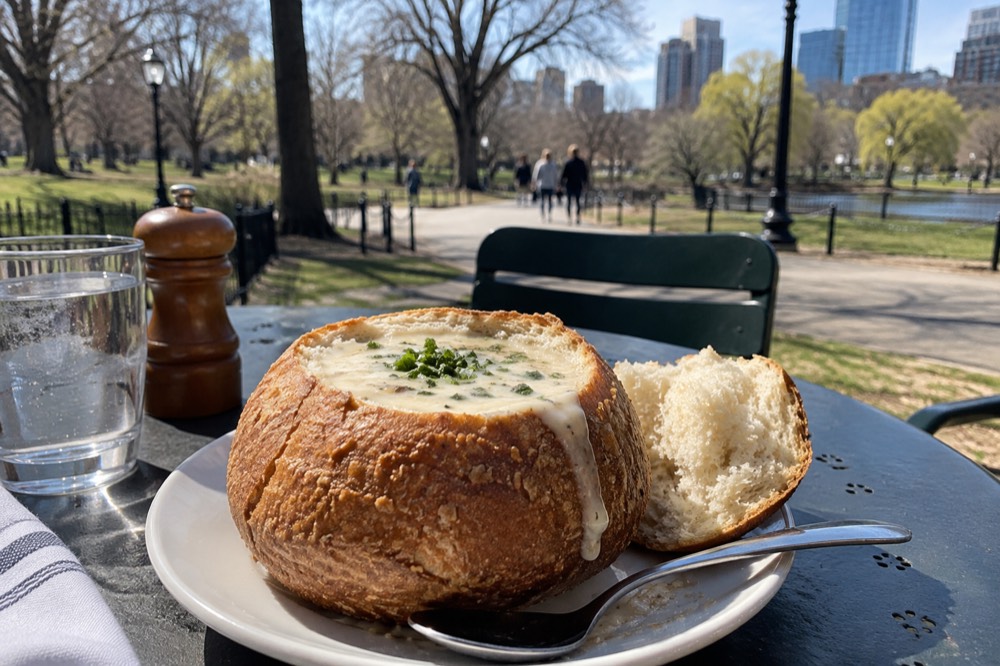
Boston clam chowder means the New England style: a milk or cream base thickened with potatoes, loaded with quahog clams, and traditionally started with salt pork rather than bacon or butter. A proper Boston bowl is dense enough that a spoon stands a chance, tastes of clam liquor rather than flour, and never contains tomato. The tomato-based Manhattan style is the punchline of a century of New England jokes, not something a Boston kitchen serves by choice.
Boston's most famous food is a soup, and the city takes it seriously enough that the New England version, cream, clams, potatoes, and salt pork, has been the standing answer to Manhattan's tomato-based rival for well over a century. The state legislature has even been the subject of a long-running local joke about outlawing the tomato version, a story the Boston Globe and others have retold for decades. This page covers where the best bowls actually are, what they cost, which neighborhoods reward a chowder crawl, and how a guided food walk can save you the guesswork.
Explore a three-hour classic Boston food walk that includes chowder among its tastings, or choose the Seaport seafood route for fish-pier context. Both involve dietary and walking constraints. A harbor cruise is a separate sightseeing option and includes no chowder or meal. Check classic Boston food walk dates
What Is Boston Clam Chowder, Actually?
Boston clam chowder means the New England style: a milk or cream base thickened with potatoes, loaded with quahog clams, and traditionally started with salt pork rather than bacon or butter. A proper Boston bowl is dense enough that a spoon stands a chance, tastes of clam liquor rather than flour, and never contains tomato. The tomato-based Manhattan style is the punchline of a century of New England jokes, not something a Boston kitchen serves by choice.
The recipe the city is judged against is old. Printed chowder recipes were appearing in Boston newspapers before the Revolution, and by the nineteenth century Boston cookbooks were printing the cream-based version that still defines the region. Salt pork is traditionally used as a fat and seasoning; it is normally salt-cured rather than smoked, and recipes vary.
What separates a great bowl from an average one comes down to three things. First, fresh clams with their liquor, the briny liquid released when they open, actually in the pot. Second, potatoes cut small enough to partly dissolve and thicken the broth naturally. Third, restraint: a chowder that tastes mostly of flour and cream was thickened the lazy way.
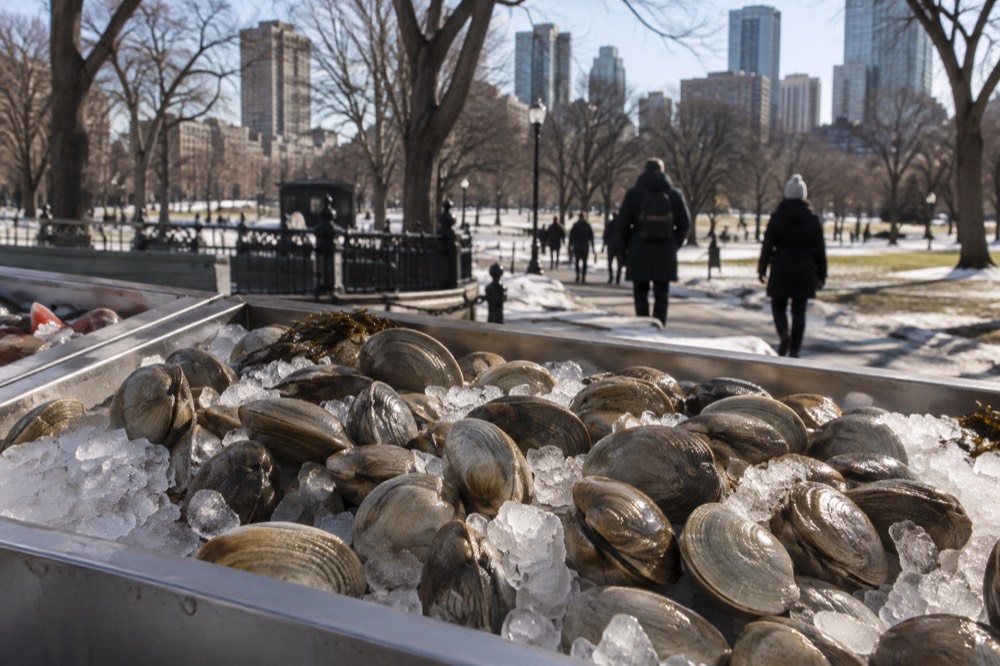
The quahog itself deserves a word. Littlenecks are a smaller size of the same hard-clam species; larger quahogs are often chopped for chowder, which is exactly why it ends up in chowder: chopped, its chew softens in the cream and its flavor carries the whole bowl. A kitchen using only small, delicate clams in chowder is paying for the wrong clam. A kitchen buying quahogs by the bushel is set up to make chowder properly.
Where To Find The Best Clam Chowder In Boston?
The best clam chowder in Boston concentrates in three areas: the North End, where Italian-American kitchens and old seafood counters serve it alongside pasta; the waterfront and Long Wharf, where the harbor-side tourist corridor has both traps and gems; and Seaport, where modern oyster bars serve a refined version. Union Oyster House near Faneuil Hall is the famous name, but the strongest bowls are usually found a few blocks off the main Freedom Trail drag, where locals actually eat.
The North End is the highest-density neighborhood for a chowder crawl because it is compact, walkable, and food-obsessed. Hanover Street and its side streets hold bakeries, counters, and old-school restaurants where chowder is a starter, not a headline. For Italian food rather than a guaranteed chowder stop, the North End Food Tour, Italian Flavors and Heritage Walk runs about 2 hours, its listing shows a 4.9 rating from 1,635 reviews, and it covers the neighborhood's food institutions in one loop. Read more in our North End neighborhood guide or check the best restaurants in Boston page for the wider picture.
The waterfront rewards skepticism. The corridor between the New England Aquarium and Faneuil Hall handles enormous foot traffic, and quality varies block by block. Ask what goes into the chowder and whether it is made in-house. A visible raw bar does not establish how the soup is prepared. Long Wharf itself is worth the walk for the harbor views alone, and the waterfront and Long Wharf area pairs well with a harbor cruise afterward.
Seaport is the newest of the three and the most changed. Two decades ago it was a working stretch of piers and surface lots; today it holds the city's densest concentration of modern oyster bars and seafood-driven kitchens. The chowder there runs lighter and cleaner than the old-school bowls, more clam liquor and less flour, and the check averages run higher with it. If your chowder ideal is the dense, spoon-standing version, the North End and the waterfront are your neighborhoods. If you want the contemporary take, Seaport is where to look.
How Much Does A Bowl Of Clam Chowder Cost In Boston?
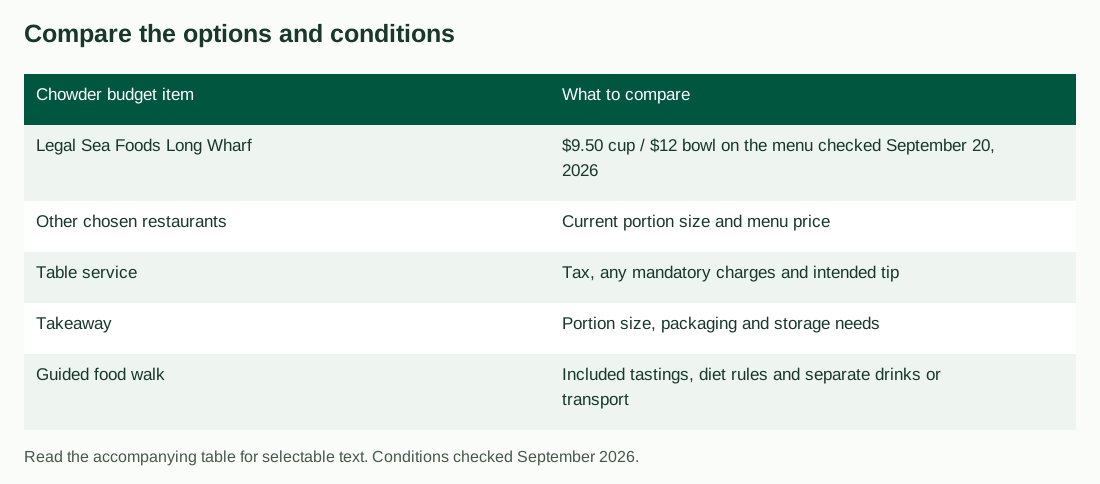
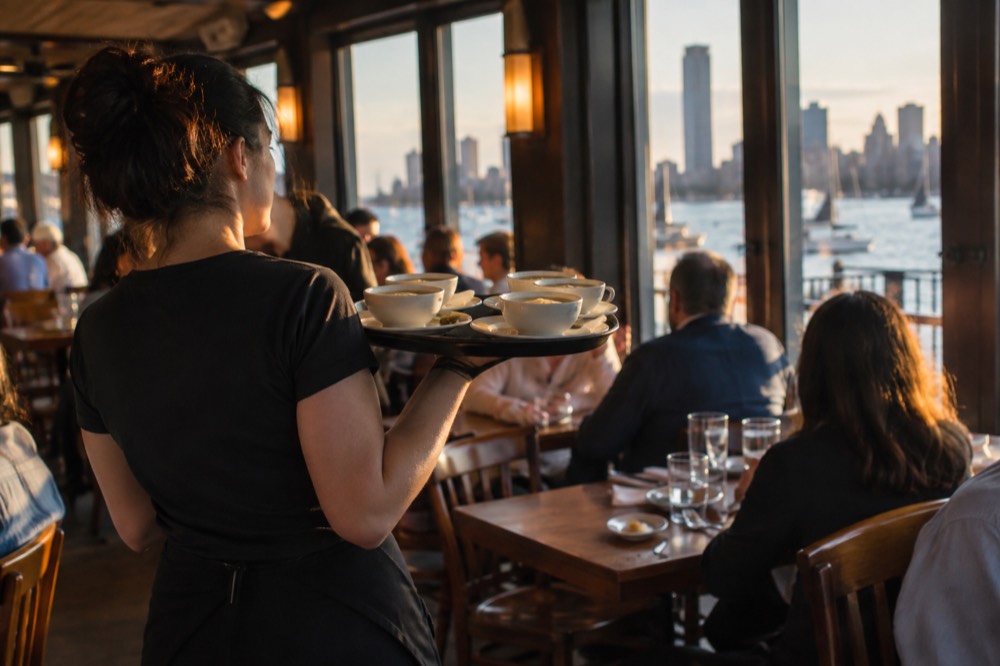
Compare actual cup and bowl prices rather than treating a neighborhood as a price band. Checked September 20, 2026, Legal Sea Foods’ Long Wharf menu lists New England clam chowder at $9.50 per cup and $12 per bowl. Other venues, portions, taxes and service charges differ; check your chosen menus before totaling a crawl.
The price ladder is fairly predictable. A cup at a takeout window near a tourist landmark sits at the low end. A bowl at a neighborhood pub lands in the middle. A quart of takeaway chowder, the way locals buy it for home, costs more up front but works out cheapest per serving.
| Chowder budget item | What to compare |
|---|---|
| Legal Sea Foods Long Wharf | $9.50 cup / $12 bowl on the menu checked September 20, 2026 |
| Other chosen restaurants | Current portion size and menu price |
| Table service | Tax, any mandatory charges and intended tip |
| Takeaway | Portion size, packaging and storage needs |
| Guided food walk | Included tastings, diet rules and separate drinks or transport |
Bundling helps if chowder is one stop on a bigger eating day. The Boston CityPASS, which the CityPASS versus Go Boston comparison breaks down, covers the Aquarium and other attractions but not restaurants, so plan food spending separately. For the full cost picture, our how much a trip costs guide covers the whole budget.
North End, Waterfront, Or Seaport: Which Boston Area Has The Best Chowder?
The North End wins for density and atmosphere, with the most serious chowder-per-block in the city inside a ten-minute walk. The waterfront wins for the classic experience, harbor views and historic dining rooms, at tourist-corridor prices. Seaport wins for the modern take, lighter bowls at oyster bars. Charlestown and South Boston hold solid neighborhood options with shorter lines.
All four are reachable on the MBTA for a $2.40 subway fare, per the fare table at the MBTA fares page.
A crawl works because the neighborhoods sit close together. The North End to the waterfront is a five-minute walk across the Rose Kennedy Greenway. Seaport is one Silver Line stop from South Station. Since 1 September 2026, MBTA riders can make unlimited transfers within a two-hour window and pay only the highest-priced leg, which may reduce eligible connection costs. The details are on the getting around Boston page.
| Area | Chowder character | Best for | Watch out for |
|---|---|---|---|
| North End | Old-school, hearty, Italian-American kitchens | A walking crawl | Weekend crowds |
| Waterfront / Long Wharf | Historic rooms, harbor views | The classic experience | Tourist-corridor pricing |
| Seaport | Modern, refined, shellfish-forward | Oyster-bar chowder | Higher check averages |
| Charlestown | Neighborhood pubs, fewer visitors | A quieter bowl | Requires a short ride |
Timing matters as much as geography. The North End is at its most crowded on weekend evenings, when the Hanover Street sidewalks fill; a weekday afternoon gets you the same kitchens with half the wait. The waterfront peaks midday with the Freedom Trail and Aquarium traffic. Seaport is busiest at dinner and on summer weekends. If your schedule allows, a weekday crawl between 2pm and 5pm hits all three neighborhoods in the gap between lunch and dinner service, when kitchens have time to talk and you can taste before committing to a full bowl. More of these guides are collected on Boston Travel Guide.
When Is Clam Chowder Season In Boston?
Clam chowder is served year-round in Boston, but it peaks in two seasons: the cold months from November through March, when a hot bowl matches a 36 °F January day, and summer, when clam shacks and tourist corridors run it at full volume. Boston's weather has no dry or wet season to plan around: every month averages between 3.21 and 4.30 inches of precipitation, and the city's 49.2 inches of annual snow falls 58% in January and February, per NOAA's 1991-2020 climate normals.
That means the "chowder weather" instinct is right in winter but the supply does not pause in summer. Local clams are harvested through the warm months, and the bowls keep coming. The practical seasonal difference is the setting: a January bowl is a refuge, a July bowl pairs with harbor views and a whale watch out to Stellwagen Bank National Marine Sanctuary, which the Boston whale watching guide covers.
| Season | Chowder scene | Pairing |
|---|---|---|
| Winter (Dec-Feb) | Peak comfort food, warm rooms | Museum afternoons, a Bruins game |
| Spring (Mar-May) | Steady, fewer crowds | Freedom Trail walking |
| Summer (Jun-Aug) | Full volume, shack windows | Harbor cruises, whale watching |
| Fall (Sep-Nov) | Shoulder season, best table odds | Foliage day trips |
The best time to visit Boston and Boston weather by month pages carry the full month-by-month picture.
Can You Tour Boston's Food Scene Instead Of Guessing?
For a tour that actually includes chowder, compare Classic Bites with the Seaport seafood walk. Classic Bites is a three-hour downtown route with four food stops; Seaport is a roughly 2.5-hour, two-mile seafood route ending around the Fish Pier. The separate North End Italian walk does not promise chowder, so choose it for its Italian-food focus rather than this dish.
A guided walk does something a solo crawl cannot: it puts you in front of kitchens that have earned decades of local trust, with the stops selected in advance; preferences and dietary fit still matter. The North End Italian walk does not promise a chowder tasting. For that specific dish, choose an experience that explicitly lists it, such as the Classic Bites option on this page.
The fish pier tour is the deeper cut. It explains the supply chain behind the bowl, which is the part of the story a restaurant menu never tells you. Its listing shows 4.9 from 557 reviews, and at 2.5 hours it fits an afternoon.
If chowder is one course in a full Boston day rather than the main event, sightseeing tours pair well: a harbor history cruise or a duck boat ride covers the city between meals, and the Boston duck tours guide compares the options.

What Not To Order: Chowder Mistakes In Boston
The three mistakes that cost visitors the most are ordering chowder inside a gift shop or cafeteria rather than a kitchen that shucks its own clams, paying harbor-view prices for a reheated bowl, and skipping the takeout quart. Boston's best chowder operations sell chowder by the pint and quart for home, often from the same pot, at a lower per-serving cost than the dine-in bowl. Ask any counter if they sell it by the quart: then ask separately whether it is made in-house; takeaway packaging alone does not prove this.
The other tell is the cracker question. A kitchen that serves oyster crackers, the traditional New England accompaniment, alongside the bowl is signaling its regional credentials. That is a soft signal, not a guarantee, and it does not establish whether the chowder was cooked that day. The same logic applies to the garnish: a scatter of fresh herbs or a drizzle of clam liquor on top does not by itself establish how the chowder was prepared.
A fourth mistake is treating chowder as a solo order. In Boston it is a starter, and the kitchens that do it best usually do the rest of the raw bar well too. If you are building a full seafood meal around your crawl, the best lobster rolls in Boston guide covers the other half of the equation, and many of the same neighborhoods apply.
One more practical note: Boston's weather station sits at Logan Airport on a harbor peninsula, so the official reading runs slightly cool on sea-breeze days, per the National Weather Service Boston office. If a chowder crawl is your rainy-day plan, it is a good one: every neighborhood on this list has enough indoor counters to ride out a shower. The rainy day guide and things to do this weekend pages carry more indoor options.
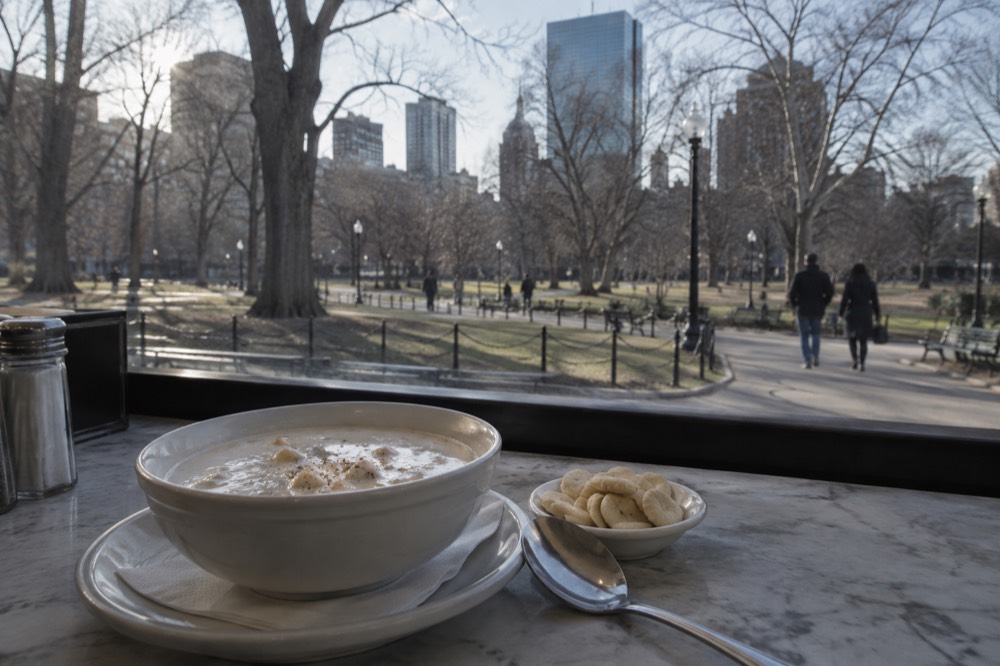
How Do You Build A One-Day Chowder Crawl In Boston?
A manageable chowder crawl can connect the North End, downtown waterfront and Seaport, choosing restaurants that actually list the dish. Check serving hours and portion sizes, and allow walking or transit time. Eligible MBTA transfers last two hours; a lunch-to-dinner crawl should not be budgeted as one fare automatically.
Budget $30 to $45 for the bowls and leave the middle of the afternoon flexible for a museum or harbor cruise between stops.
The order matters less than the pacing. Three bowls in three hours is a tasting crawl; five is a chore. Ask for a cup, not a bowl, at the first two stops and save the full bowl for whichever kitchen impressed you most. Ask whether a cup or smaller portion is offered rather than assuming an unlisted option, because the chowder comes from the same pot.
| Stop | Neighborhood | What to order | Time of day |
|---|---|---|---|
| First | North End | A cup, plus a pastry for the walk | Lunch, 11:30am-1pm |
| Second | Waterfront | A cup with harbor views | Mid-afternoon, 2-4pm |
| Third | Seaport | A full bowl, plus the raw bar | Dinner, 5:30pm onward |
If the crawl is part of a longer trip, the where to stay in Boston page helps you pick a base that keeps all three neighborhoods in walking or one-ride range, and the CharlieCard and fares page explains the payment details behind the transfer window.
Curious about seeing the harbor between your own meal stops? Explore the one-hour narrated cruise from Long Wharf. Leave time to reach boarding and check your sailing; food and drinks are extra, so it is sightseeing rather than a chowder tasting. Check harbor cruise departure times
Common Questions About Clam Chowder In Boston
what is the best clam chowder in boston
Taste is personal. Legal Sea Foods’ Long Wharf menu explicitly lists New England clam chowder, and its Harborside location also serves it. Ask about ingredients and preparation rather than assuming a raw bar, neighborhood or takeaway quart proves quality. For a guided tasting, choose Classic Bites or the Seaport seafood walk, which actually list chowder.
how much does clam chowder cost in boston
Legal Sea Foods’ Long Wharf menu lists $9.50 for a cup and $12 for a bowl when checked September 20, 2026. Prices and portions differ elsewhere. Add applicable taxes, charges and any tip when comparing a restaurant crawl with a food walk.
is boston clam chowder the same as new england clam chowder
Yes. Boston's chowder is the New England style: a milk or cream base with clams, potatoes, and traditionally salt pork. The Manhattan tomato version is the regional rival that New Englanders have joked about banning for over a century.
where should I eat clam chowder in the north end
The North End's chowder sits in its old-school Italian-American kitchens and seafood counters along Hanover Street and the side streets around it. A 2-hour guided food walk rated 4.9 from 1,635 reviews on its listing covers Italian food stops but does not guarantee chowder; check the actual inclusions before booking.
is clam chowder available year-round in boston
Yes. Boston has no wet or dry season, every month averages between 3.21 and 4.30 inches of rain per NOAA's 1991-2020 normals, and local clam harvests continue through summer. Chowder peaks as comfort food in winter and runs at full volume in the tourist season.
can I buy clam chowder to take home in boston
Many of the city's serious chowder kitchens sell it by the pint or quart for takeaway, often from the same pot as the dine-in bowls, at a lower cost per serving. Ask separately about ingredients and in-house preparation; selling quarts does not establish either.
Choose Chowder Tastings Or Plan Your Own Food Stops
These options do not match your choice. Adjust the selection or reset to explore the starting recommendation.
Compare Your Food Walk Or Independent Crawl Totals
Reader-entered estimates in USD, not live quotes. Use the same dates and travelers for both options. Include all relevant tickets, rooms, taxes, mandatory fees and transport for the entire trip once in each total. Do not add a transfer twice if your rate already includes it.
Boston Classics Food And History Walk
A three-hour downtown walk with four food stops: baked beans and brown bread, chowder, lobster roll and Boston cream pie. Most tastings are seated; walking between venues is outdoors. Vegan and gluten-free diets cannot be accommodated. Recommended ages 12+; no infants, toddlers or strollers. Alcohol is an optional paid upgrade.
A starting option to explore. Choose dates, travelers and the exact booking option with the provider; availability and eligibility are confirmed there.
Check classic Boston food walk dates