Boston Common And The Public Garden
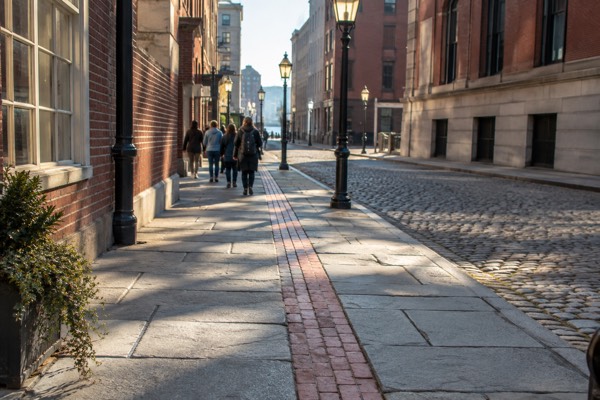
Boston Common and the Public Garden are two different parks that most visitors experience as one continuous walk, and the difference between them is the whole point of the visit. The Common is an open, democratic field of grass and paths, a place for protests, picnics, sledding, and shortcutting office workers. The Public Garden, directly across Charles Street, is a deliberate work of art: a Victorian landscape garden with a lagoon, formal flower beds, and a famous family of bronze ducklings. The Freedom Trail starts at the Common's Visitor Center, the Swan Boats dock sits in the Garden's lagoon, and almost every walking route through central Boston passes through one or the other. This guide from Boston Travel Guide covers what each park is, what is free, what is closed right now, and how to build the visit into a wider day in the city.
Short answer
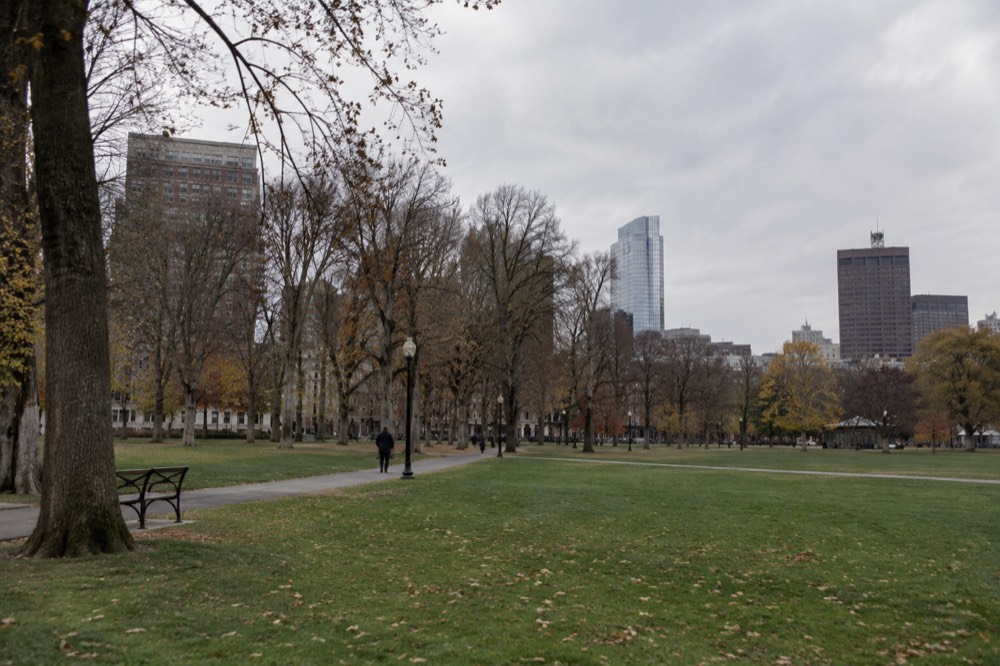
Boston Common is a broad, open public park at the foot of Beacon Hill, and the Public Garden is the ornamental Victorian garden immediately across Charles Street. The Common is the informal one: lawns, ball fields, the Frog Pond, and the starting point of the Freedom Trail. The Garden is the formal one: a four-acre lagoon, bedding flowers rotated by season, suspension footbridges, and the Make Way for Ducklings bronze statues. Locals treat them as one continuous green spine through the center of the city.
Boston Common and the Public Garden are two different parks that most visitors experience as one continuous walk, and the difference between them is the whole point of the visit. The Common is an open, democratic field of grass and paths, a place for protests, picnics, sledding, and shortcutting office workers. The Public Garden, directly across Charles Street, is a deliberate work of art: a Victorian landscape garden with a lagoon, formal flower beds, and a famous family of bronze ducklings. The Freedom Trail starts at the Common's Visitor Center, the Swan Boats dock sits in the Garden's lagoon, and almost every walking route through central Boston passes through one or the other. This guide from Boston Travel Guide covers what each park is, what is free, what is closed right now, and how to build the visit into a wider day in the city.
Both parks are free to explore. Want the historical story as you leave the Common? Explore the downtown Freedom Trail walk, or compare a longer Charlestown route below; admission to paid historic interiors is separate. Check Freedom Trail walk dates
What Are Boston Common And The Public Garden?
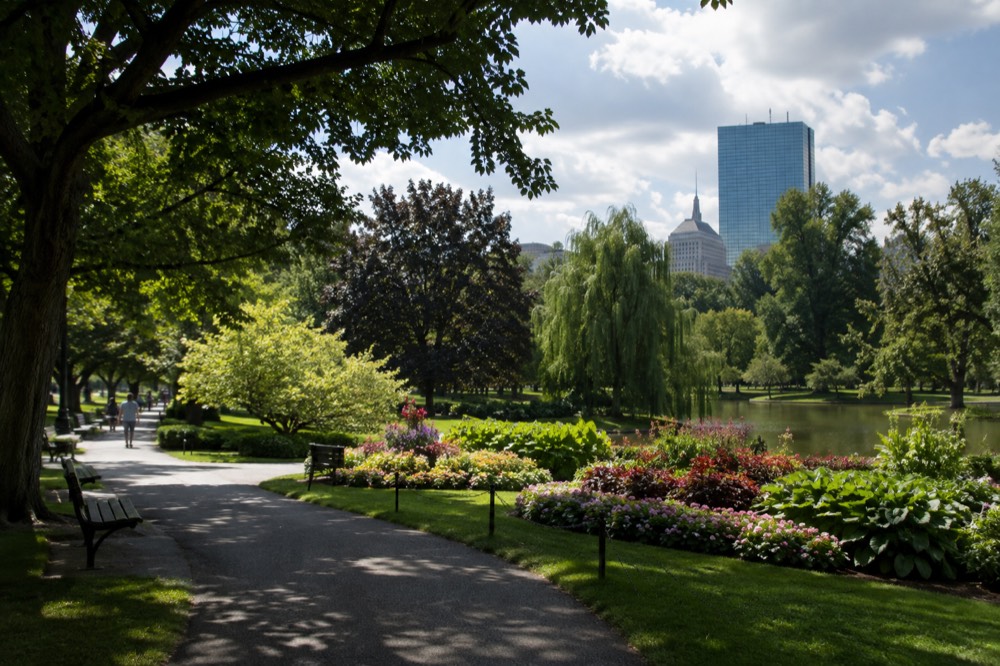
Boston Common is a broad, open public park at the foot of Beacon Hill, and the Public Garden is the ornamental Victorian garden immediately across Charles Street. The Common is the informal one: lawns, ball fields, the Frog Pond, and the starting point of the Freedom Trail. The Garden is the formal one: a four-acre lagoon, bedding flowers rotated by season, suspension footbridges, and the Make Way for Ducklings bronze statues. Locals treat them as one continuous green spine through the center of the city.
The pairing is not an accident of planning, it is a story about how American parks changed. The Common has served as common land since the colonial era: a grazing field, a military mustering ground, and eventually the city's shared front yard. The Public Garden came later, built in the style that was sweeping cities in the Victorian era, with a designed lagoon, exotic plantings, and promenade paths meant for display rather than grazing. Walking from one to the other across Charles Street, the shift from open lawn to planted parterre is visible within about twenty paces.
The two parks also anchor the geography of central Boston. Beacon Hill rises north of the Common, with the Massachusetts State House looking down over it. The Charles River sits just west of the Garden, and the Charles River Esplanade continues the green space along the water. Back Bay stretches west from the Garden's far corner, which means a visitor staying in either downtown or Back Bay will likely cross one of these parks within the first hour of sightseeing.
| Feature | Boston Common | Public Garden |
|---|---|---|
| Character | Open common land, lawns and paths | Ornamental Victorian landscape garden |
| Signature water | Frog Pond (seasonal ice rink in winter) | Lagoon with Swan Boat dock |
| Best-known feature | Freedom Trail starting point | Make Way for Ducklings statues |
| Typical use | Walking, picnics, events, sledding | Strolling, photographs, flower viewing |
| Direct neighbors | Beacon Hill, Downtown, Theater District | Back Bay, Charles River, Beacon Hill |
Is Boston Common Free To Visit?
Yes, both parks are free and open to the public, with no gates, tickets, or entry fees at any time of year. The Freedom Trail, which starts at the Common's Visitor Center, is also free to walk on your own: the Freedom Trail Foundation describes a 2.5-mile red-lined route linking 16 historic sites, and only 4 of those 16 sites charge admission. The fee-charging sites are the Old South Meeting House, the Old State House, the Paul Revere House, and the Old North Church.
The public Freedom Trail can be followed without a ticket, with separate fees for some interiors. Old State House and Old South Meeting House currently share an $18 adult admission ticket. Paul Revere House and Old North Church set their own rates and options. Free sites such as Bunker Hill and USS Constitution still have hours and entry conditions; the ship is Navy-operated.
Further reading: the NPS hours and fees page.
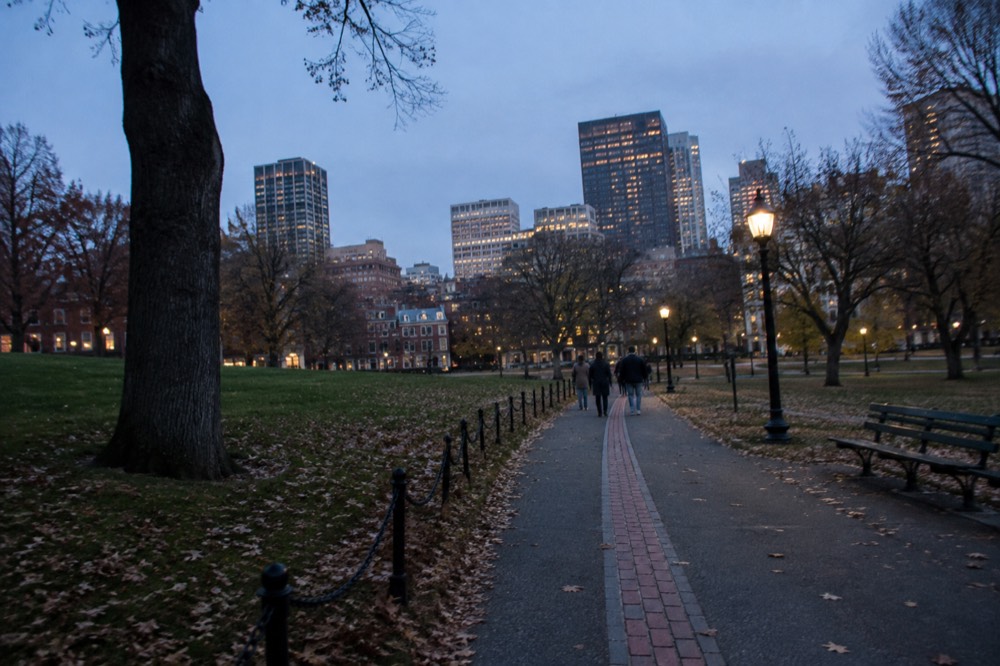
For a deeper route through the same ground, the Freedom Trail guide covers all 16 sites in order, and the Faneuil Hall and Quincy Market guide picks up where the trail leaves the Common. If you would rather have a guide than a paper map, small-group walks are the strongest category in this part of the city, and the three below are the ones this site rates most consistently for first visits.
Are The Swan Boats Running In The Public Garden?
The Swan Boats’ 2026 season ended September 7, and the operator expects to return in April 2027. The next exact opening date is not yet specified here. The Public Garden remains a separate free walking destination; a pass or other tour ticket cannot make the lagoon boats run outside their season.
The closure matters for planning more than it might seem. The Swan Boats are the Public Garden's headline activity, and the lagoon they circle is the park's visual center. In the closed season the lagoon is still there, still photogenic, and the footbridges still carry visitors across it, but the ride itself, a slow pedal-powered circuit that has run in the Garden for generations, waits for spring. The Swan Boats guide tracks the season dates and what replaces the ride in the off-season.
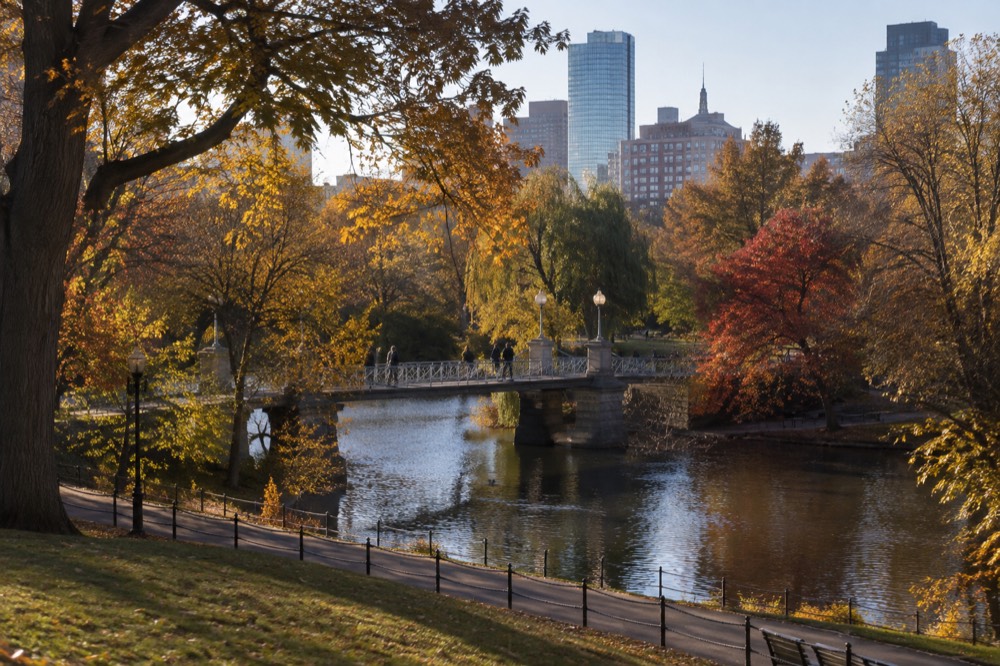
What does still run on the water near the parks? Harbor and river outings have different seasonal schedules and boarding points, and the amphibious duck boats drive past the Common and splash into the Charles. If the lagoon ride was the plan, a harbor sunset cruise or a duck boat splashdown is the closest substitute, but their operating dates need checking: Duck Tours do not run through winter.
Check Duck Tour dates before choosing it as a separate water outing. It enters the Charles River rather than the Public Garden lagoon and is seasonal; choose your actual departure at the Prudential Center, Museum of Science or aquarium. Check Duck Tour dates
What Can You Do In The Parks In Each Season?
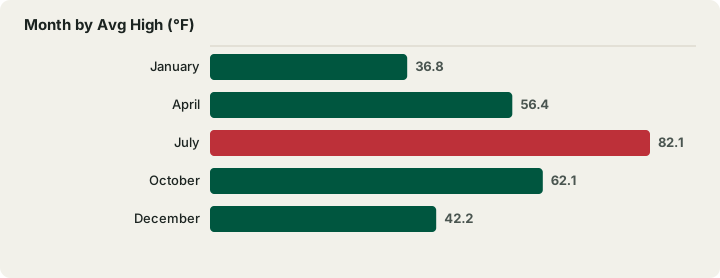
Each season changes the parks completely: winter brings ice skating on the Common's Frog Pond and snow on the lawns, spring brings the Garden's bulb displays and the Swan Boats' April reopening, summer brings free summer theater and concert traditions on the Common, and fall brings foliage color to both parks. Boston's weather supports all of it. NOAA's 1991 to 2020 normals show July as the warmest month at an 82.1°F average high, and 49.2 inches of annual snow, 58% of it in January and February alone.
The winter case is stronger than most visitors expect. The Frog Pond converts to an outdoor ice rink, and the Common's slopes are the city's default sledding ground, because the snow statistics back it up: January averages 14.3 inches and February 14.4 inches. The Garden in snow is one of the quietest, most photographed scenes in the city, with the duckling statues standing in fresh white. Anyone planning a cold-weather trip should read the dedicated winter planning material on the main things to do page.
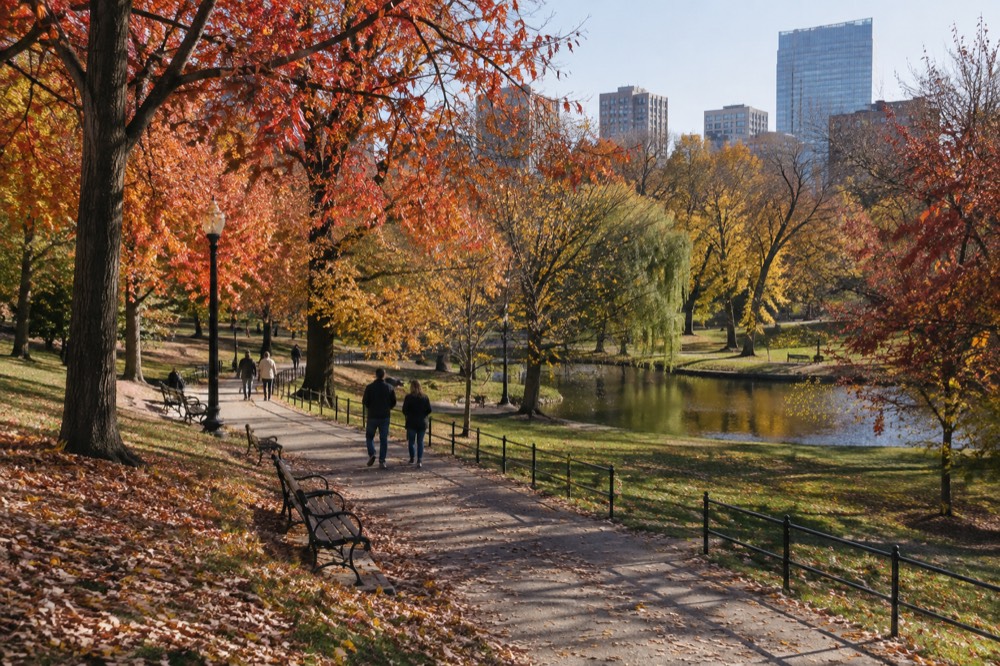
Spring and fall are the photographers' seasons. The Garden's beds are replanted on a rotating schedule, so the tulip display of April and May gives way to summer plantings, then to chrysanthemums and late color. One planning fact that surprises people: Boston has no wet season and no dry season at all. Every month of the year averages between 3.21 and 4.30 inches of precipitation, a spread of about one inch, so packing for rain is a year-round habit here rather than a seasonal one.
| Month | Avg High (°F) | Avg Low (°F) | Precip (in) | Snow (in) | What the Parks Look Like |
|---|---|---|---|---|---|
| January | 36.8 | 23.1 | 3.39 | 14.3 | Frog Pond rink, sledding slopes |
| April | 56.4 | 40.8 | 3.63 | 1.6 | Bulb displays, Swan Boats reopen |
| July | 82.1 | 66.0 | 3.27 | 0.0 | Full leaf, lagoon at its greenest |
| October | 62.1 | 47.5 | 4.03 | 0.2 | Peak foliage color on both parks |
| December | 42.2 | 29.2 | 4.30 | 9.0 | Holiday lights, bare formal beds |
Source for the climate figures: NOAA's monthly normals, 1991 to 2020, recorded at the official Boston station at Logan Airport, a maritime site that reads slightly cool for inland neighborhoods on sea-breeze days.
How Do You Get To Boston Common By Subway?
Boston Common and the Public Garden sit at the center of the MBTA network, with subway stops on three sides, and a single subway ride costs $2.40. The closest stations are Park Street on the Red and Green lines at the Common's northeast corner, Boylston on the Green line at the southeast corner, and Arlington on the Green line beside the Public Garden's west edge. A 1-Day pass costs $11.00 and a 7-Day pass $22.50, both valid for unlimited subway and local bus travel.
The fare rules changed on 1 September 2026, and older guides have not caught up. The MBTA's fare pilot now gives riders unlimited transfers between subway, bus, and ferry within a two-hour window, paying only the cost of the highest-priced leg, provided the same payment method is used across all legs. Before the change, riders got at most two transfers with further limits. For a visitor stringing together the Common, the North End, and a ferry in one morning, the new window is a genuine saving.
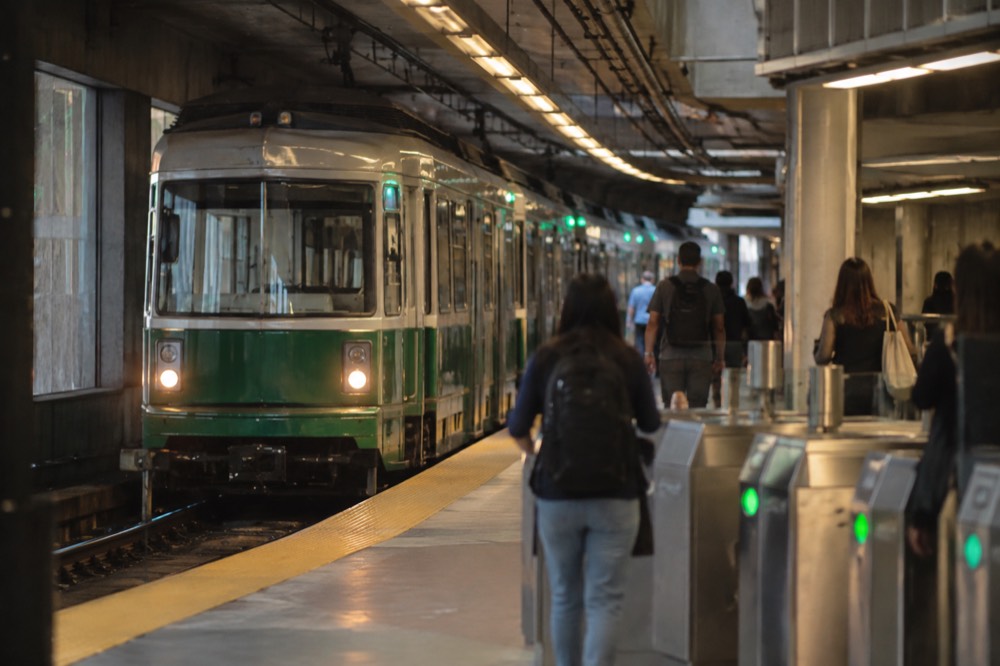
One pass detail matters at the point of purchase. A 1-Day or 7-Day pass loaded on a CharlieTicket starts at the date and time of purchase, while the same pass on a CharlieCard starts at first use. Buy on arrival evening, start sightseeing next morning, and the CharlieCard version is worth most of a day more. Contactless Tap to Ride with a card or phone also works on bus, subway, and ferry. The MBTA publishes the full fare table at its fares page.
| MBTA Fare | Price | Notes |
|---|---|---|
| Subway one-way | $2.40 | Red, Orange, Green, Blue lines |
| Local Bus one-way | $1.70 | Express Bus dropped to this rate in the 2026 pilot |
| 1-Day Pass | $11.00 | 24 hours of unlimited travel |
| 7-Day Pass | $22.50 | Compare against your actual paid trips and transfers |
| 2-hour transfer window | Pay highest leg only | Same payment method required, from Sept 1, 2026 |
One current disruption to check before a Green Line day: rolling weekend closures for track work run through September and into October 2026, including a full central Green Line suspension on the weekend of 19 to 20 September, with free shuttle buses provided. Symphony station on the Green Line E branch has been closed since June with closure scheduled through spring 2029. The MBTA posts current diversions on its own site.
What Should You See Near Boston Common And The Public Garden?
The parks are surrounded by more first-tier sightseeing than almost any other green space in the United States: the Massachusetts State House looks over the Common from Beacon Hill, the Boston Public Library and Copley Square sit a short walk west in Back Bay, the Theater District borders the Common's south edge, and the Freedom Trail's red line departs the Common toward Faneuil Hall and the North End. Everything on that list is within roughly fifteen minutes on foot.
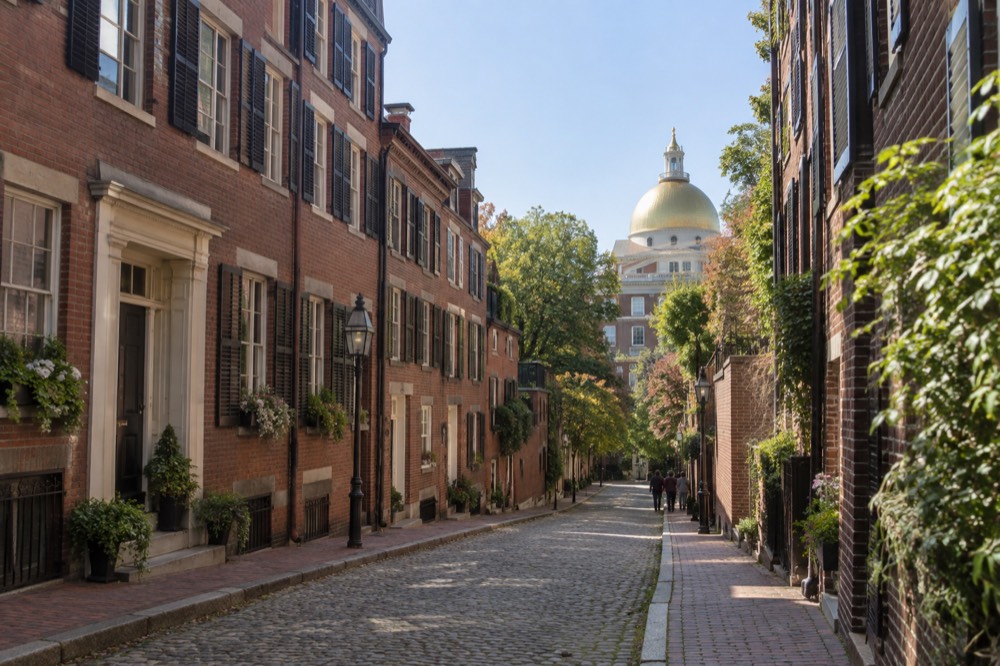
Beacon Hill deserves the walk even on a tight schedule. The brick rowhouses and gas-lamp side streets climb from the Common’s northern edge toward the State House, and the neighborhood's Acorn Street is one of the most photographed lanes in the city. West of the Garden, Back Bay's Newbury Street shopping and the Boston Public Library fill a half-day easily, and the library's McKim courtyard and reading room are free to enter, a question so many visitors ask that this site keeps a dedicated answer on walking into the library.
| Direction | What You Reach | Walk Time From the Parks | Guide |
|---|---|---|---|
| North | Beacon Hill and the Massachusetts State House | Under 5 minutes | Beacon Hill guide |
| South / North | Theater District to the south; TD Garden events north via downtown | Venue-dependent walk | TD Garden guide |
| West | Back Bay, Newbury Street, Copley Square | 5 to 15 minutes | Back Bay guide |
| East | Downtown Crossing and the Freedom Trail's route | 10 minutes | Freedom Trail guide |
| Beyond | North End eateries past Faneuil Hall | 20 to 25 minutes | North End food tour |
The MFA and Gardner Museum require a separate journey toward Fenway. Green E serves the Museum of Fine Arts stop; Orange Line Ruggles is another approach with a longer walk. Gardner admission is free for ages 17 and under, visitors named Isabella and all visitors Thursday evenings 5–9 p.m.; reserve ahead.
Which Tours Work Best With A Visit To The Parks?
Three tours pair especially well with the parks: the Boston Duck Boat Sightseeing City Tour with Cruise, from $62, rated 4.6 from 10,003 reviews, which has three designated departure locations and splashes into the Charles; the Harvard University Campus Guided Walking Tour, from $23, rated 4.7 from 3,864 reviews, a short Red Line ride away; and Boston's North End Food Tour, from $70, rated 4.9 from 1,635 reviews, covering the Italian neighborhood on the Freedom Trail before its Charlestown section.
Rather see the city from an open-air ride? Book a hop-on hop-off trolley ticket here.
Check the cancellation deadline for the exact option and date before reserving.
A Duck Tour is a distinct city-and-Charles-River outing, lasting about 80 minutes, with designated boarding away from the lagoon. It does not replace the Swan Boats’ short garden circuit or provide Public Garden boat access. Check the booked departure location and seasonal schedule.
Park Street has direct Red Line service to Harvard Square in Cambridge. The university offers a free official historical tour with reservations and a self-guided alternative; a paid student-led walk is another option. Plan the actual campus access and return journey rather than assuming a fixed duration.
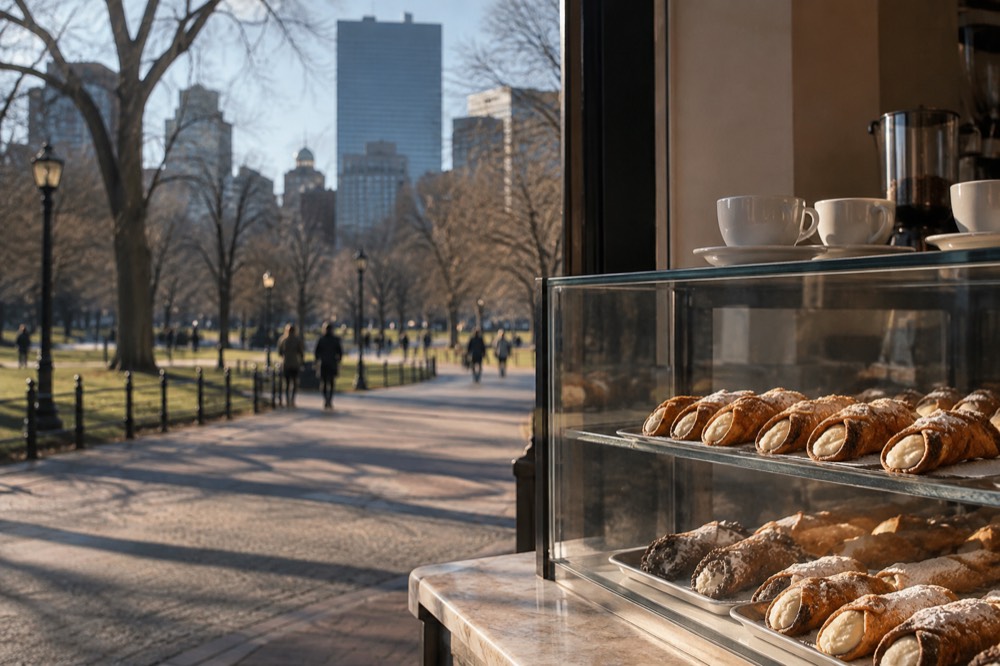
The North End food tour is the reward at the end of a Freedom Trail day. The 2-hour walk covers the Italian bakeries, salumerias, and pastry shops of the neighborhood where Paul Revere's house stands, and its listing shows a 4.9 rating from 1,635 reviews, among the strongest in the food category. Pair it with a morning in the parks and the trail, and it turns a walking day into a full one.
If the budget allows only one paid activity in the parks' orbit, the small-group walking tours are the category this site rates most consistently: the Freedom Trail History Small Group Walking Tour runs 2 hours 30 minutes from $39 with a 4.9 rating from 7,835 reviews, and the longer Freedom Trail Walking Tour with Bunker Hill and USS Constitution covers 4 hours from $79 with a perfect 5 rating from 864 reviews.
Common Questions About Boston Common And The Public Garden
Is Boston Common free?
Yes, both parks have free public admission, subject to park rules, opening hours and any temporary closures. The Freedom Trail is free to walk independently; some historic interiors, skating and rides have separate charges.
What is the difference between Boston Common and the Public Garden?
The Common is older and informal: open lawns, the Frog Pond, ball fields, and gathering space. The Public Garden is a designed Victorian landscape garden with a lagoon, formal flower beds, suspension footbridges, and the Make Way for Ducklings statues. They meet at Charles Street.
Are the Swan Boats open?
No. The Swan Boats' own site reads "Closed for the season. See you in April 2027." They normally run daily April through September. Until spring, the lagoon and its bridges are still open to walk through, but the ride itself is not running.
What subway stop is Boston Common?
Park Street station, on the Red and Green lines, sits at the Common's northeast corner and is the standard stop. Boylston on the Green line serves the southeast corner, and Arlington on the Green line sits beside the Public Garden. A subway ride costs $2.40.
Can you ice skate in Boston Common?
Frog Pond operates a seasonal winter rink with its own opening schedule, weather conditions, admission and skate-rental charges. Check the current rink notice before going; do not skate on the Public Garden lagoon.
How much time do you need for Boston Common and the Public Garden?
Plan on 60 to 90 minutes to walk both parks at a normal pace, longer in spring or fall when the Garden's beds are at their best. Visitors adding Beacon Hill, the Freedom Trail's first stretch, or Back Bay typically spend half a day in and around the two parks.
Choose A Guided Outing Around Your Free Park Visit
These options do not match your choice. Adjust the selection or reset to explore the starting recommendation.
Compare Your Guided Outing Totals
Reader-entered estimates in USD, not live quotes. Use the same dates and travelers for both options. Include all relevant tickets, rooms, taxes, mandatory fees and transport for the entire trip once in each total. Do not add a transfer twice if your rate already includes it.
Freedom Trail Small-Group Walk
A guided walk exploring the Revolutionary history along the Freedom Trail. The trail can also be walked independently. Review the meeting point and route before booking.
A starting option to explore. Choose dates, travelers and the exact booking option with the provider; availability and eligibility are confirmed there.
Check Freedom Trail walk dates