Fall Foliage Day Trips From Boston: Where To Find The Best Color
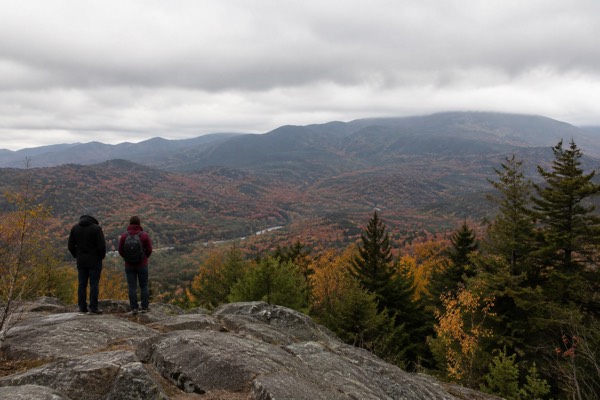
Fall color is the one thing Boston cannot deliver on demand. The city has its ginkgos and its maples, and the Public Garden turns convincingly gold, but the landscape New England is famous for, whole hillsides of red and orange running to the horizon, starts an hour or more outside the city and gets better the farther you go. The good news is that Boston is unusually well placed for chasing it. Color builds in the northern mountains first, then works south and east toward the coast, so the season arrives in waves over several weeks rather than all at once, and a well-timed day trip can put you in the middle of it.
Short answer
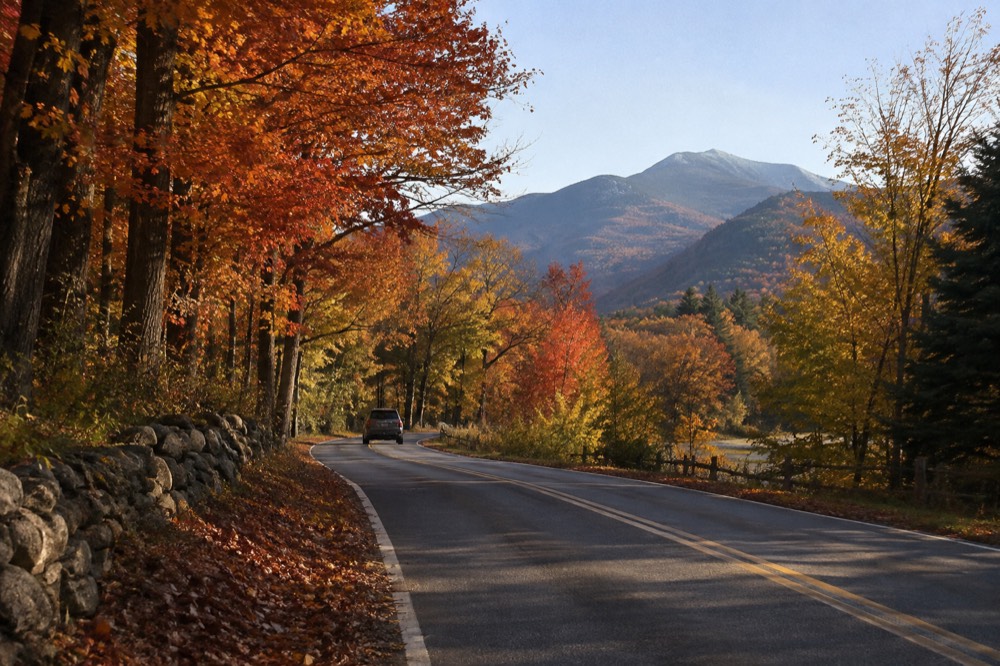
Color moves south and east across New England over roughly a month, starting in the northern mountains and finishing at the coast, which means Boston itself is one of the last places in the region to peak. The White Mountains turn first, the Berkshires follow, and the lowlands around Boston and the harbor turn last, so a visitor based in the city may find color within driving range during different parts of the season simply by moving north or west as the weeks pass.
Fall color is the one thing Boston cannot deliver on demand. The city has its ginkgos and its maples, and the Public Garden turns convincingly gold, but the landscape New England is famous for, whole hillsides of red and orange running to the horizon, starts an hour or more outside the city and gets better the farther you go. The good news is that Boston is unusually well placed for chasing it. Color builds in the northern mountains first, then works south and east toward the coast, so the season arrives in waves over several weeks rather than all at once, and a well-timed day trip can put you in the middle of it.
Want a full mountain day with the driving arranged? Compare the 12-hour White Mountains outing with western Massachusetts–Vermont or a shorter Lexington trolley circuit. Check current color conditions and the actual travel date; no tour can guarantee peak foliage. Check foliage trip dates and pickup
This page lays out the foliage day trips that actually work from Boston: where the color is, when to go, how to get there without a car if you would rather not drive mountain roads, and what a day of leaf peeping realistically costs. The White Mountains guide covers the single most popular foliage destination in the region in more depth, and the general day trips overview lists every out-of-city option in one place.
When Does Fall Foliage Peak Near Boston?
Color moves south and east across New England over roughly a month, starting in the northern mountains and finishing at the coast, which means Boston itself is one of the last places in the region to peak. The White Mountains turn first, the Berkshires follow, and the lowlands around Boston and the harbor turn last, so a visitor based in the city may find color within driving range during different parts of the season simply by moving north or west as the weeks pass.
No official agency publishes a fixed peak date, and any guide that prints one is guessing. What is verifiable is the pattern: elevation and latitude drive the schedule, so the high country of New Hampshire loses its green weeks before the salt marshes south of Boston do. That pattern is the whole strategy. Early in the season, drive far. Late in the season, stay close.
The practical version looks like this. Plan the mountain trips first, when the northern color is at its best and the Boston canopy is still green. Save the near-city options, the Concord and Lexington battle road, the Middlesex Fells, the Charles River banks, for the later weeks when the color has come down to sea level. The Boston in fall guide tracks what is happening inside the city itself during those same weeks.
Weather matters more than the calendar. An early hard frost or a windy rainstorm can strip a region in a day, which is why foliage travelers watch forecasts rather than trusting a week chosen months in advance. Boston's own autumn is mild by New England standards: the NOAA 1991-2020 normals for Logan, the official station, show September averaging a 73.1 °F high against a 58.2 °F low, October cooling to 62.1 and 47.5, and November dropping to 51.6 and 37.9. Those are coastal readings from a harbor peninsula, and inland valleys run a few degrees warmer on sunny afternoons and colder at night, which is exactly the swing that triggers the color.
What Are The Best Fall Foliage Day Trips From Boston?
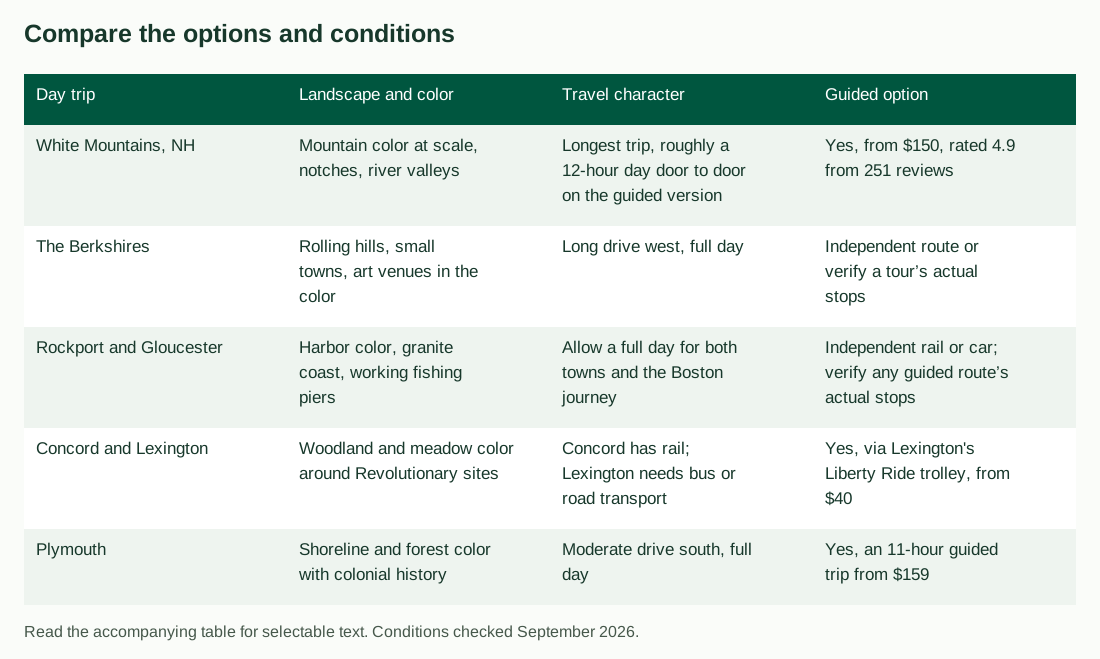
The five strongest foliage day trips from Boston are the White Mountains of New Hampshire, the Berkshires in western Massachusetts, the Rockport and Gloucester coast north of the city, the Concord and Lexington battle road just west of it, and the Plymouth shore to the south. Each pairs a different kind of color, mountains, hills, harbor or forest, with a different drive time, and several have guided tour options that remove the driving entirely.
The comparison that matters is not which destination has the best color, since all five peak at good color in a normal year, but which kind of landscape you want and how much of the day you are willing to spend getting to it. The table below lays out the trade.
| Day trip | Landscape and color | Travel character | Guided option |
|---|---|---|---|
| White Mountains, NH | Mountain color at scale, notches, river valleys | Longest trip, roughly a 12-hour day door to door on the guided version | Yes, from $150, rated 4.9 from 251 reviews |
| The Berkshires | Rolling hills, small towns, art venues in the color | Long drive west, full day | Independent route or verify a tour’s actual stops |
| Rockport and Gloucester | Harbor color, granite coast, working fishing piers | Allow a full day for both towns and the Boston journey | Independent rail or car; verify any guided route’s actual stops |
| Concord and Lexington | Woodland and meadow color around Revolutionary sites | Concord has rail; Lexington needs bus or road transport | Yes, via Lexington's Liberty Ride trolley, from $40 |
| Plymouth | Shoreline and forest color with colonial history | Moderate drive south, full day | Yes, an 11-hour guided trip from $159 |
Check the actual route rather than relying on a regional tour title. A western Massachusetts–Vermont excursion visits a different area from Lenox, Stockbridge and Mount Greylock. Also, the White Mountains day is genuinely long: the White Mountains foliage trip runs 12 hours, and anyone who books it should know that going in rather than discovering it on the bus.
For a first foliage trip, the White Mountains is the one most travelers remember. For a relaxed version, the coast north of Boston delivers real color with a fraction of the driving and a lobster roll at the end of it.
Why Is The White Mountains Trip The Classic Foliage Day Trip?
The White Mountains trip is the classic because it is the only destination on this list where the foliage is the whole landscape rather than a backdrop, a 12-hour guided day trip from Boston that runs into New Hampshire's mountains and back for a listed price of $150 per person, rated 4.9 from 251 reviews on its listing. The route crosses the same notch roads and river valleys that made New England foliage famous, and the operator handles the mountain driving.
The case for going guided here is stronger than anywhere else on this page. Mountain roads in peak foliage season are congested, parking at the scenic overlooks fills by mid-morning, and the driver needs to concentrate on the road. A guided coach turns those hours into viewing time. The Boston to New Hampshire Fall Foliage White Mountains Day Trip is the direct option, and its listing shows the full 12-hour shape of the day, so read it before booking and plan nothing else for that evening.
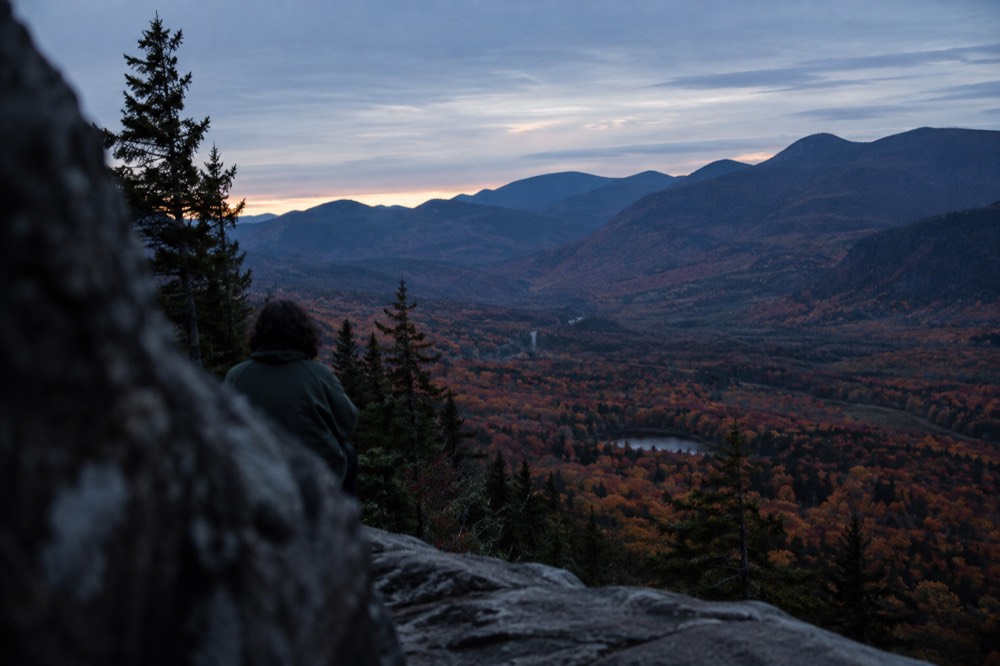
What you are buying is a planned route and transport, not a guarantee of peak color. The mountains color up well before Boston does, so this trip works in the early weeks of the season when a stay-in-town foliage hunt would show mostly green. If your dates fall late in the season, the reverse is true and the mountains may already be bare while the coast is still holding color, which is when the Rockport direction becomes the smarter call.
The trade-off is stamina. Twelve hours with a pickup in central Boston means an early start and a late return, and the foliage season in the mountains coincides with some of the first cold mornings of the year. The NOAA normals put September nights in Boston at 58.2 °F on average and October nights at 47.5, and the mountain valleys run colder than the coast. Bring layers, not a hoodie.
Is The Berkshires Worth The Drive From Boston?
The Berkshires are the best foliage landscape within Massachusetts itself, a region of wooded hills, small towns and cultural venues in the western part of the state, but they sit far enough west that the round trip consumes most of a day so choose a specific route and verify any tour’s actual stops. It suits an independent driving itinerary, best suited to travelers who want the state's best inland color and do not mind five-plus hours of total driving.
What the Berkshires offer that the mountains do not is variety at human scale. The color runs across rolling hills rather than up mountain walls, and it wraps around towns, galleries and concert venues rather than pure wilderness. The Berkshires day trip page covers the destinations in detail. For foliage specifically, the region's color tends to arrive after the White Mountains and before the Boston coast, which makes it the middle weekend of a well-planned foliage season.
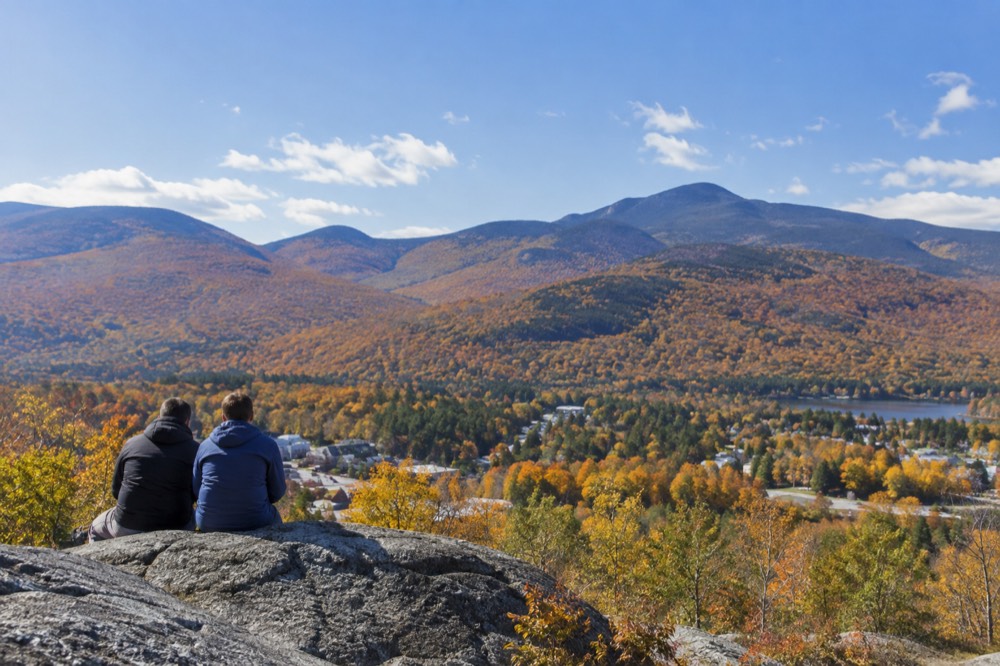
The honest warning is traffic. The same scenery that fills the coach on the New Hampshire trip fills the two-lane roads of the Berkshires with slow-moving leaf peepers on peak weekends, and the popular towns fill their parking early. Go on a weekday if the schedule allows, go early in the day regardless, and pick one or two anchor stops rather than trying to tour the whole region in a day.
Budget the day realistically. Between the drive west, the drive back and a real stop or two, the Berkshires is a dawn-to-dusk outing, closer in shape to the White Mountains trip than to the half-day coastal runs. Travelers who want the hills without the mileage should look at Concord instead, which delivers genuine woodland color 20 miles from downtown.
Check a rental car for a Berkshires route built around your own towns, viewpoints and museum hours. Compare Boston pickup and return arrangements, driver requirements and the deposit. Add fuel, parking and any admission to the car total, and choose a manageable number of stops. Compare Boston car rentals
Where Can You See Fall Color On The Coast Near Boston?
The coast north of Boston, around Rockport and Gloucester, and the shoreline south toward Plymouth both turn late in the season, which makes them the right foliage destinations for the final weeks of color when the mountains have already gone bare. The Rockport and Gloucester trip is the shortest genuine foliage outing from the city, close enough that a half day covers it, and it pairs the color with a working harbor and the region's best lobster shacks.
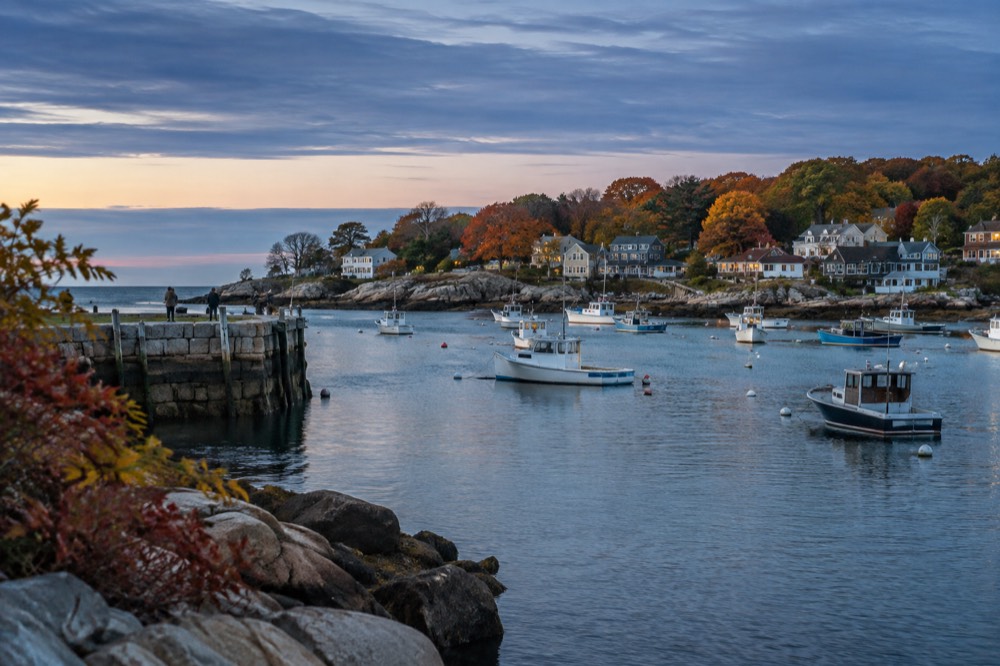
Coastal color is a different experience from mountain color, and it photographs differently. The reds and oranges sit against gray granite and blue water instead of running unbroken to a ridgeline, and the harbors give every viewpoint a foreground. The Rockport and Gloucester guide covers the stops, including the whale watching operations that run out of Gloucester toward Stellwagen Bank National Marine Sanctuary, which the NOAA sanctuary program documents at stellwagen.noaa.gov.
South of the city, Plymouth works the same trick with colonial history attached. The Boston to Plymouth day trip, an 11-hour guided outing listed from $159 and rated 4.8 from 424 reviews, strings Quincy, Plimoth Patuxet and the Mayflower II into one day, and the inland stretches of that route carry solid late-season color. The Plymouth day trip page has the full breakdown.
The coastal timing rule is the mirror image of the mountain rule. If it is late in the season and the forecasts say the mountains have peaked and dropped, the coast is where the remaining color is. If it is early, do the reverse and leave the coast for later. Everything else covered here is indexed on Boston Travel Guide.
Want coastal history with an autumn route? Explore the Plymouth–Sandwich day tour, whose itinerary changes from late September through November for foliage. Confirm the specific stops and admissions for your date; a fall route is not a guarantee of peak color. Check Plymouth and Cape Cod tour dates
Can You Do A Foliage Day Trip Without A Car?
Yes, and in some cases it is the better option: the MBTA's Commuter Rail runs from Boston stations into Concord, Salem, Gloucester and other foliage towns for one-way fares between $2.40 and $13.25 depending on zone, and since 1 September 2026 riders can make unlimited transfers between subway, bus and ferry within a two-hour window while paying only the highest-priced leg. A carless foliage day is entirely practical for the near destinations.
The Commuter Rail is the tool most visitors never consider. The Fitchburg Line reaches Concord, the Newburyport/Rockport Line reaches the North Shore, with the Rockport branch for Gloucester and Rockport, and the lines out of North Station and South Station cover a wide ring of woodland towns that all carry real color. The MBTA's own fare pages publish the zone structure and the transfer rules, and the fare table lives at mbta.com/fares. Check weekend schedules carefully: some branches run thin service on Sundays, and maintenance diversions are common in autumn, including the rolling weekend closures the MBTA has scheduled on the Orange, Green and Red lines through September and into October.
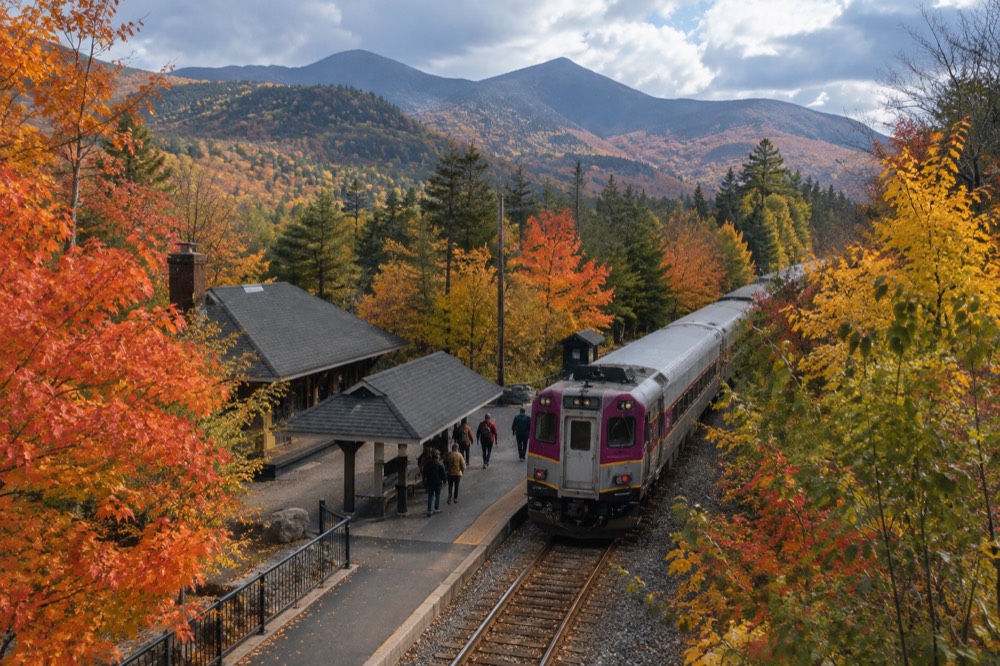
For the far destinations, the guided coach tours are the carless answer. The White Mountains trip, the Plymouth trip and the Martha's Vineyard trip all depart from central Boston and handle every mile of the driving. The Boston to Martha's Vineyard Day Trip with Optional Island Tour runs 12 hours, is listed from $129, and carries a 4.5 rating from 3,302 reviews, and while the Vineyard is a beach-and-harbor destination first, the ferry crossing and the island's roads carry seasonal scenery when the dated trip is operating. The Martha's Vineyard day trip page covers the island itself.
One payment note that saves real money: the MBTA's 1-Day Pass costs $11.00 and the 7-Day Pass $22.50, but the same pass behaves differently by medium. On a CharlieTicket the pass starts at purchase, while on a CharlieCard it starts at first use, a difference the MBTA spells out on its fares page. For a visitor buying on arrival and starting the next morning, that is most of a day of validity at stake.
How Much Does A Fall Foliage Day Trip From Boston Cost?
For a rail-based foliage day, compare the destination’s zone fare with the $10 weekend commuter rail pass when applicable. Local Boston transit and paid attractions may cost extra. A Lexington trolley ticket excludes Boston transport, while mountain coach trips include the road journey; compare current whole-party totals with a rental car, fuel, parking and meals.
The spread is wide because the formats are different products. The table below uses the current listing prices for the guided options and the MBTA's published fares for the transit options, and treats driving as a variable cost that depends on distance and parking, which in Boston proper is expensive enough to matter.
| Format | Example | Listed cost per person | Time commitment |
|---|---|---|---|
| Commuter Rail day trip | Concord via Fitchburg Line | $2.40-$13.25 each way by zone, with a separate commuter rail ticket; the $11 subway/bus LinkPass does not cover Concord | Half to full day |
| Guided trolley at the destination | Liberty Ride in Lexington | From $40 | 1 hour 30 minutes |
| Guided coach day trip | White Mountains foliage | From $150 | 12 hours |
| Guided coach day trip | Plymouth and Mayflower II | From $159 | 11 hours |
| Guided coach day trip | Martha's Vineyard | From $129 | 12 hours |
| Self-drive | Berkshires loop | Fuel and parking, varies | Full day, dawn to dusk |
Two things the table cannot show. The guided coach prices are per person and typically cover transport and guiding rather than food, so budget a lunch stop into any 11 or 12-hour day. And the transit figures assume no surprise diversions: autumn weekend maintenance work on the MBTA is routine, and a planned closure with shuttle replacement can stretch a simple rail outing by an hour.
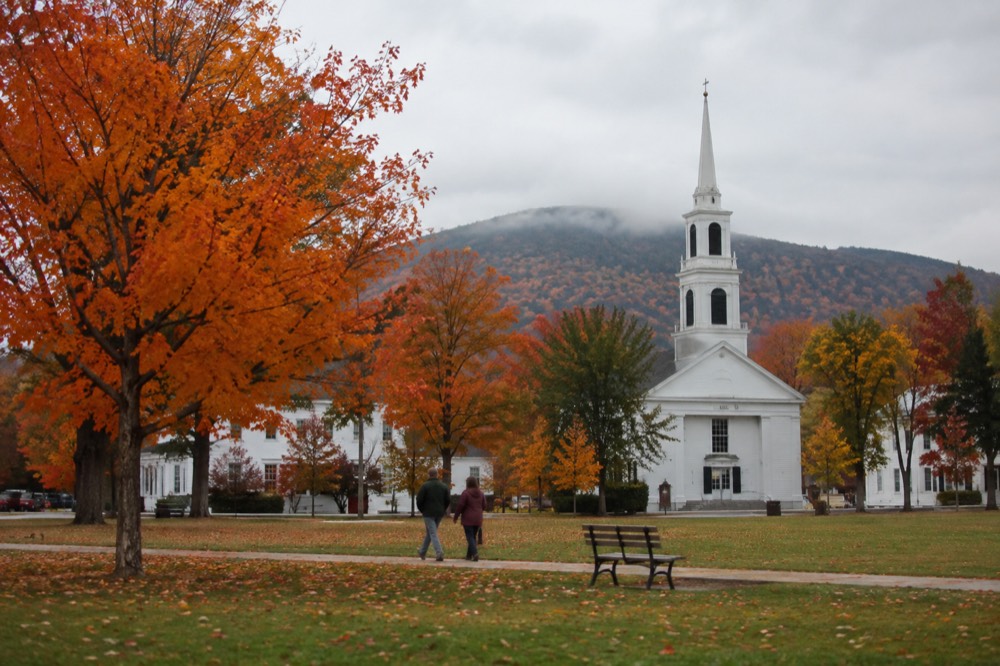
For travelers stacking foliage days onto a longer stay, the pairing that works best is one long guided day plus one or two short self-directed ones. The 3-day Boston itinerary absorbs a foliage day trip cleanly as day three, and the things to do in Boston overview covers what to do with the in-city days between trips.
Want a shorter narrated outing instead of another 12-hour day? Explore Liberty Ride from Lexington, a 90-minute circuit through Lexington and Concord. Arrange Boston transport separately; no hop-on/hop-off or house-museum admission is included. Check Lexington Liberty Ride dates
What Does Fall Weather In Boston Actually Look Like?
Boston’s autumn cools steadily and has no distinct dry season: the NOAA 1991-2020 normals for the official Logan station show September at a 73.1 °F average high and 58.2 °F low, October at 62.1 and 47.5, and November at 51.6 and 37.9, with monthly precipitation sitting between 3.56 and 4.03 inches across the three months.
The official reading comes from a harbor peninsula, so it runs slightly cool for inland neighborhoods and slightly warm for the mountain valleys where the foliage peaks.
The precipitation number deserves its own sentence, because it kills a common planning myth. Boston has no wet season and no dry season at all: every month of the year sits between 3.21 and 4.30 inches of precipitation, a spread of about one inch across all twelve months, so there is no month to avoid for rain and no month to chase for dryness. What actually moves the needle is snow, 49.2 inches a year on average, 58% of which falls in January and February alone, while small amounts can also fall in October and November.
| Month | Avg high | Avg low | Precipitation | Snow |
|---|---|---|---|---|
| September | 73.1 °F | 58.2 °F | 3.56 in | 0.0 in |
| October | 62.1 °F | 47.5 °F | 4.03 in | 0.2 in |
| November | 51.6 °F | 37.9 °F | 3.66 in | 0.7 in |
Source: NOAA NCEI monthly climate normals, 1991-2020, station USW00014739 at Boston Logan International Airport, the station documented through the National Weather Service's Boston office at weather.gov/box.
The planning translation: layers, and more of them than the coastal forecast suggests. A 62 °F October afternoon in Boston can be a 45 °F afternoon in a New Hampshire notch, and foliage days spend real time standing still at overlooks, which is the coldest way to spend a mild day.
What Should You Do If The Foliage Season Is Already Ending?
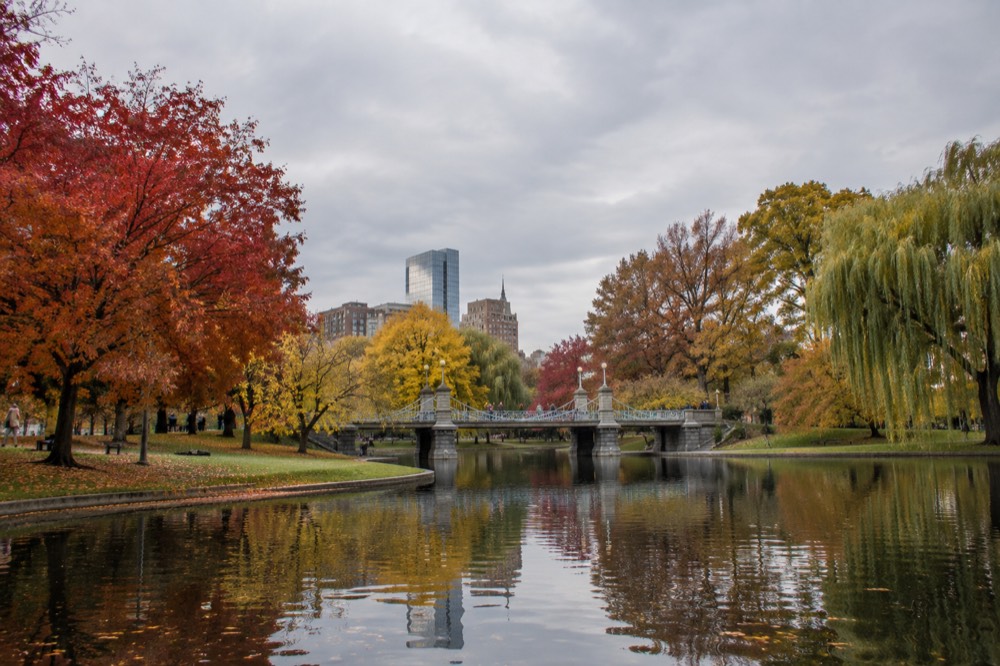
If the season is late and the mountains have dropped their leaves, pivot to the destinations that color last: the coast north of Boston around Rockport and Gloucester, the harbor islands before the ferry season ends on 12 October 2026, and the city's own parks, where the Public Garden and the Common hold color into November in a normal year. Late-season leaf peeping from Boston is a low-and-close game, not a long-distance one.
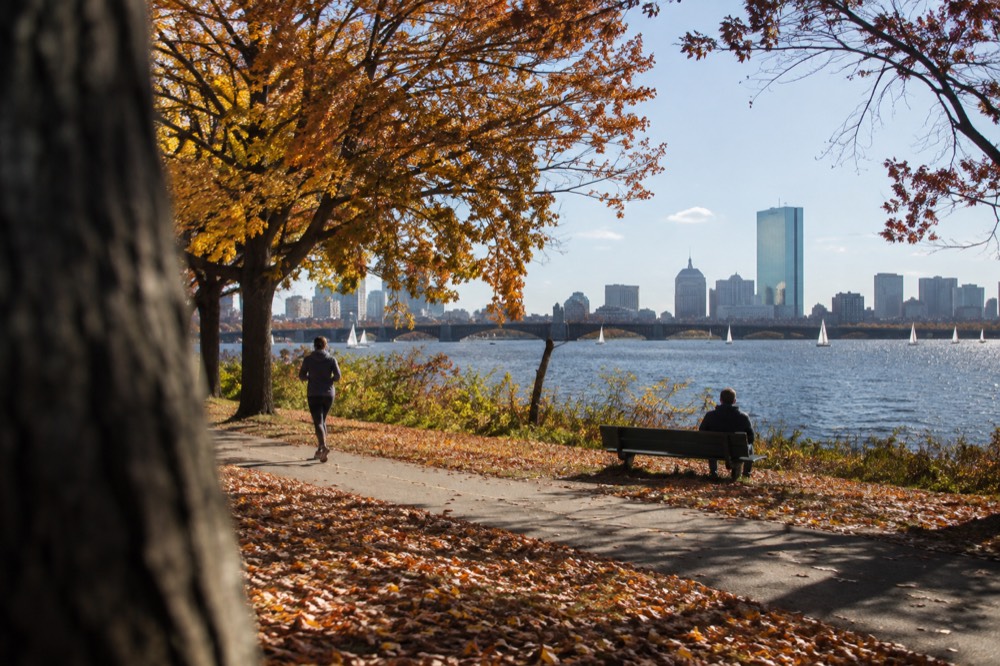
The city itself is a legitimate late-season destination, and most out-of-town guides underrate it. The Charles River Esplanade, the Arnold Arboretum and the Public Garden all carry real color, and the Arboretum in particular holds varied species that turn on staggered schedules, stretching the show later than any single-species woodland. The free things to do guide covers the no-cost version of this plan.
If there is still one long day in the schedule, the Salem direction combines late color with the October atmosphere Salem trades on, and the Salem day trip page covers the timing warnings that matter in that month. The Salem History and Hauntings guided walk, listed from $36 and rated 4.8 from 816 reviews, is the structured version, and Salem's Best Ghost Tour runs from $24 with a 4.6 rating from 4,431 reviews for the shorter evening format.
The last rule of foliage planning is the one that saves the most disappointment: buy refundable. Color is a forecast, not a schedule, and the operators' listings carry their own cancellation terms, which is worth reading before committing to a 12-hour mountain day booked months out. The same logic applies to hotels: the where to stay guide covers the neighborhoods that make an early coach departure painless.
Check a central Boston stay if early departures shape your trip. Boston Park Plaza is at 50 Park Plaza; compare the booked room and full stay total, then verify your particular tour’s meeting point. The hotel booking does not include a tour or guarantee pickup at its door. Check rooms at Hilton Boston Park Plaza
Common Questions About Fall Foliage Day Trips From Boston
what are the best fall foliage day trips from boston?
The White Mountains of New Hampshire, the Berkshires, the Rockport and Gloucester coast, the Concord and Lexington battle road, and Plymouth. The White Mountains trip is the classic for scale, the coast is the best short option, and Concord is the easiest half day.
when is peak foliage in new england?
No official source publishes fixed peak dates, and any guide printing them is guessing. The verified pattern is that color starts in the northern mountains, moves south and east, and finishes at the coast, so the peak depends on where you stand: the White Mountains turn well before Boston does.
can you see fall foliage from boston without a car?
Yes. The MBTA Commuter Rail reaches Concord, Salem, Gloucester and other foliage towns for one-way fares of $2.40 to $13.25 by zone, and the guided coach tours to the White Mountains, Plymouth and Martha's Vineyard all depart from central Boston.
how much does a foliage day trip from boston cost?
Compare actual zone fares with the $10 weekend commuter rail pass for eligible rail outings. Add local travel, meals and any admission. Lexington’s trolley excludes travel from Boston; full-day coaches and rental cars have different inclusions, so compare dated whole-party totals.
is october a good time to visit boston for foliage?
Yes, and October is when the color reaches the city itself. Boston's October normals run a 62.1 °F average high against a 47.5 °F low, with about 4 inches of rain spread across the month, and the coastal and in-city color holds later than the mountains.
what if the leaves are already gone when i visit?
Pivot low and close: the coast north of Boston, the Boston Harbor Islands before the ferry season ends on 12 October 2026, and the city's parks, which hold color into November in a normal year. Late-season leaf peeping from Boston is a short-distance game.
Match Your Foliage Route To The Time You Have
These options do not match your choice. Adjust the selection or reset to explore the starting recommendation.
Compare Your Foliage Day Totals
Reader-entered estimates in USD, not live quotes. Use the same dates and travelers for both options. Include all relevant tickets, rooms, taxes, mandatory fees and transport for the entire trip once in each total. Do not add a transfer twice if your rate already includes it.
White Mountains Fall Foliage Day Trip
An approximately 12-hour scenic road trip from Boston through the White Mountains. Confirm the assigned downtown pickup; airport pickup is not included. Lunch is separate, mountain restrooms can be basic, and peak leaf color is not guaranteed.
A starting option to explore. Choose dates, travelers and the exact booking option with the provider; availability and eligibility are confirmed there.
Check foliage trip dates and pickup