Concord And Lexington: A Day Trip From Boston
The American Revolution began in two small towns west of Boston. On an April morning, colonial militia faced British regulars on Lexington Green, and hours later a second confrontation at Concord's North Bridge pushed the redcoats into a fighting retreat back toward the city. The Freedom Trail Foundation describes its Boston route as covering "over 250 years" of history across 16 sites, but the trail's story actually starts, militarily speaking, out here. Both towns are close to the city, both are compact, and both reward a full day.
Short answer
The battles of Lexington and Concord were the first military engagements of the American Revolution, and they happened about an hour from downtown Boston. The British march out of the city and the militia response that met it turned a political dispute into a war. The National Park Service preserves the key ground as Minute Man National Historical Park, and the towns keep their 18th-century centers largely intact.
The American Revolution began in two small towns west of Boston. On an April morning, colonial militia faced British regulars on Lexington Green, and hours later a second confrontation at Concord's North Bridge pushed the redcoats into a fighting retreat back toward the city. The Freedom Trail Foundation describes its Boston route as covering "over 250 years" of history across 16 sites, but the trail's story actually starts, militarily speaking, out here. Both towns are close to the city, both are compact, and both reward a full day.
Want a guide and transport from Boston? Compare the 7–8-hour Lexington–Concord minibus day, including Concord Museum. If you can reach Lexington yourself, the shorter Liberty Ride trolley visits both towns; the free park grounds remain an independent option. Check Lexington and Concord day tour dates
This page lays out how to plan a Concord MA day trip from Boston: the transport options, what to see in each town, what the day costs, and a realistic one-day route. For a wider look at the region's options, see the site's day trips from Boston roundup, and for the city itself start with things to do in Boston.
Why Do Concord And Lexington Matter To A Boston Visitor?
The battles of Lexington and Concord were the first military engagements of the American Revolution, and they happened about an hour from downtown Boston. The British march out of the city and the militia response that met it turned a political dispute into a war. The National Park Service preserves the key ground as Minute Man National Historical Park, and the towns keep their 18th-century centers largely intact.
A visitor who has walked Boston's Freedom Trail has seen where the story was debated; here is where it turned to gunfire.
The connection runs both directions. The Freedom Trail's 16 sites in Boston include Faneuil Hall, where the rhetoric that provoked the march was honed, and the Old South Meeting House, where the tea raid that preceded the march was organized. The National Park Service's published hours-and-fees page for Boston National Historical Park lists free outdoor stops alongside paid historic interiors, so the city half of the Revolutionary story is cheap to absorb. The country half, out in Lexington and Concord, is just as accessible.
A guided walk in the city pairs naturally with the country. The Freedom Trail History Small Group Walking Tour, from $39 per person and rated 4.9 from 7,835 reviews on its listing, covers the Boston end of the story in two and a half hours, and its dedicated tour page breaks down what it includes. Doing the city walk one day and the Lexington and Concord ground the next is the shape most history-focused visitors settle into.
How Do You Get From Boston To Concord And Lexington?
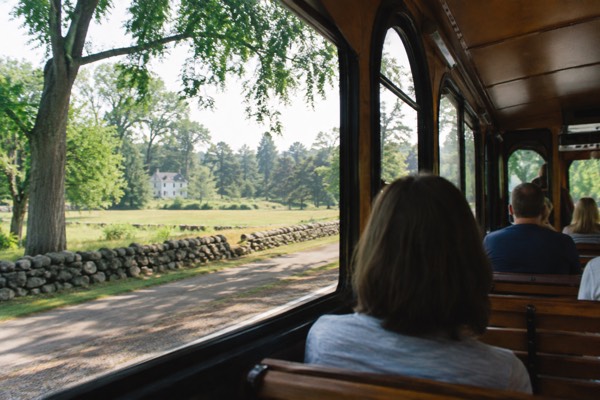
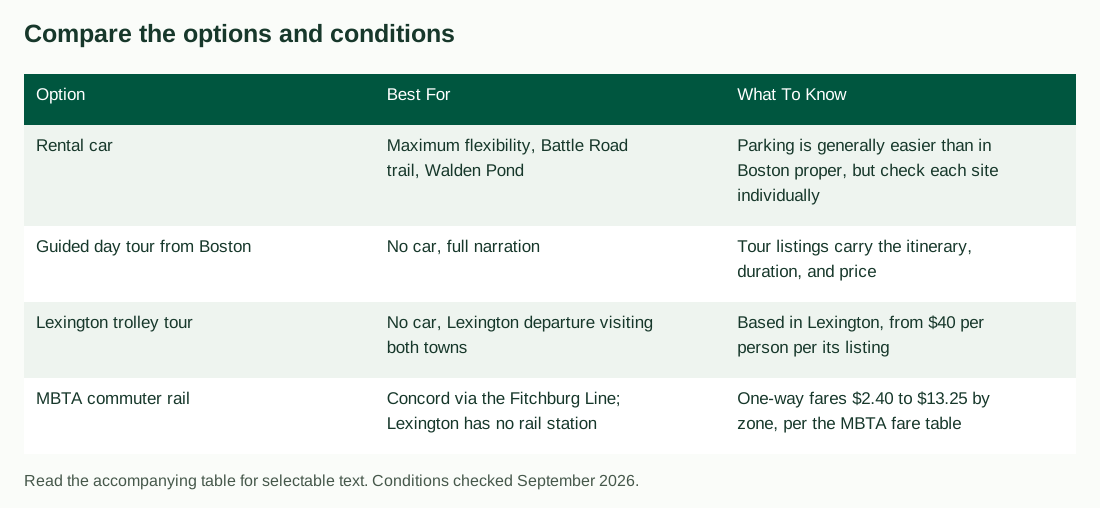
Driving is the most flexible way to do a Concord MA day trip from Boston, since both towns sit west and northwest of the city and a car lets you string Lexington, the Battle Road stretch of the national park, and Concord in one loop. Guided tours are the alternative for visitors without a car, including a trolley tour based in Lexington itself. The MBTA's fare table shows commuter rail one-way fares from $2.40 to $13.25 depending on zone for regional trips.
The practical difference between the towns is small but real: Lexington and Concord are separate towns a short drive apart, and the national park land between them, including the Battle Road trail, is what makes a car or a tour vehicle genuinely useful. Visitors who stay in Boston without a car can still do this trip, but the day needs more planning, and the guided options carry more of the load. Check rail schedules and station locations against your exact plan before relying on transit for this route.
| Option | Best For | What To Know |
|---|---|---|
| Rental car | Maximum flexibility, Battle Road trail, Walden Pond | Parking is generally easier than in Boston proper, but check each site individually |
| Guided day tour from Boston | No car, full narration | Tour listings carry the itinerary, duration, and price |
| Lexington trolley tour | No car, Lexington departure visiting both towns | Based in Lexington, from $40 per person per its listing |
| MBTA commuter rail | Concord via the Fitchburg Line; Lexington has no rail station | One-way fares $2.40 to $13.25 by zone, per the MBTA fare table |
The MBTA's fare rules changed on September 1, 2026: the transit authority now runs an unlimited-transfer pilot within a two-hour window, paying only the highest-priced leg, on the same form of payment. The MBTA fare page carries the details. That matters for getting to a departure point in the city, less for the trip out to the towns themselves.
Curious about building your own route through the battle towns and Walden Pond? Compare Boston car rentals for the day. Check pickup and return hours, driver and deposit terms, then add fuel, parking and any house-museum tickets. Compare Boston car rentals
What Should You See In Lexington First?
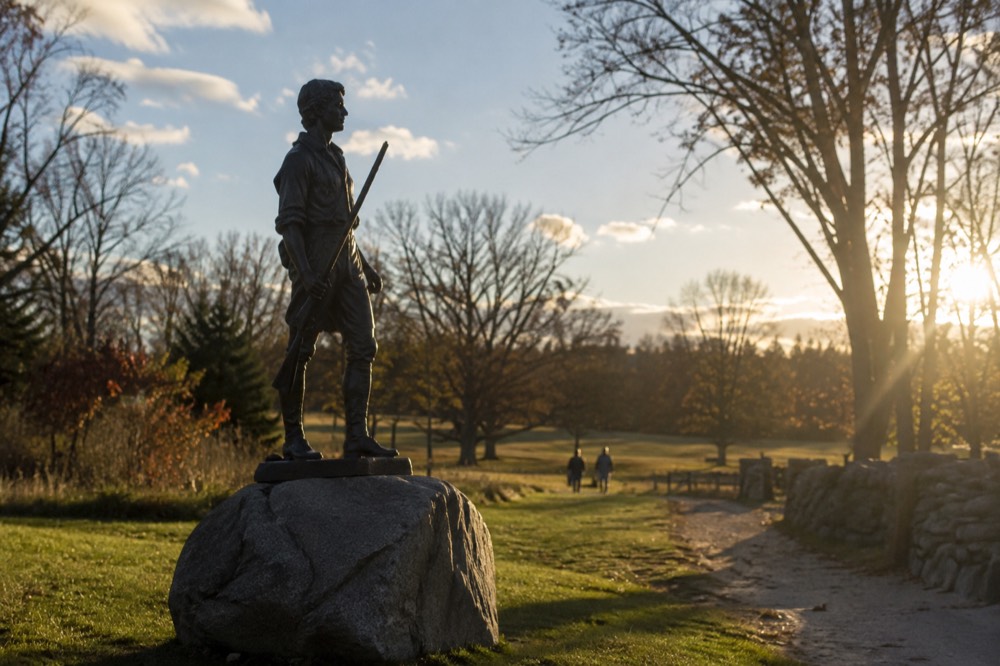
Start at Lexington Green, the town common where the first shots of the Revolution were fired, and where the Minute Man statue and the oldest of the town's Revolutionary-era monuments stand today. The green is small, walkable in minutes, and surrounded by historic buildings, including Buckman Tavern, where the militia waited that morning. Give the green and its immediate surroundings at least an hour before moving on, and longer if you go inside the tavern or the Hancock-Clarke House.
Lexington's center is compact enough that the walk between the green and the surrounding sites takes minutes rather than hours. The town's historical sites keep their own hours and seasons, so check each one's own page before locking an itinerary. What does not change is the geography: everything of consequence in the town center sits within a short walk of the green.
The Liberty Ride Trolley Tour, run in Lexington, covers the town's battle-era sites from a trolley with a guide. Its listing shows it from $40 per person, rated 4.6 from 409 reviews, running an hour and a half. The Lexington Liberty Ride trolley tour page on this site has the full rundown, and Check availability if a narrated circuit of the town suits your day.
The trolley starts in Lexington but visits both Lexington and Concord, including the North Bridge. It returns to Lexington and is not hop-on/hop-off; arrange the trip from Boston separately. A longer Boston departure provides more time and a different itinerary, while driving lets you add stops such as Walden Pond.
What Are The Essential Stops In Concord?
Concord's anchor stop is the North Bridge in Minute Man National Historical Park, the site of the confrontation that turned the British retreat into a battle, with the Minute Man statue at its near end and the grave of British soldiers at its far side. From there, work through the town's literary and colonial center: the Old Manse beside the bridge, Sleepy Hollow Cemetery, and the cluster of authors' homes Concord is famous for. Concord's center is walkable, but the bridge and cemetery require additional walks or short drives.
Concord carries a second, quieter claim to fame: it was home to Emerson, Thoreau, Hawthorne, and the Alcotts, and the town's historic house museums cover both the Revolutionary era and that literary century. Walden Pond, the state reservation around the pond where Thoreau lived for two years, sits a short drive from the center and doubles as a swimming and walking spot in warm months.
| Concord Stop | What It Is | Planning Note |
|---|---|---|
| North Bridge | Site of the famous Revolutionary confrontation | Within Minute Man National Historical Park, no fee at the bridge itself |
| Old Manse | Historic house beside the bridge | Colonial-era home; check seasonal hours |
| Walden Pond | State reservation, Thoreau's cabin site | Swimming and walking in season, parking fills on summer weekends |
| Sleepy Hollow Cemetery | Authors' Ridge graves | Open grounds, walkable year-round |
| Concord Museum | Town history, Revolutionary to literary | Check the museum's own page for hours and fees |
The park itself is the spine of the day. The National Park Service maintains the Battle Road stretch between Lexington and Concord, and walking even a section of it connects the two towns' stories into one continuous narrative. The NPS hours and fees page for Minute Man National Historical Park is the authoritative source for what charges and what does not.
Want to include Concord Museum or Orchard House alongside other paid Boston-area visits? Explore the Explorer Pass choices and compare their direct prices first. Reserve any required visit separately; do not spend another pass choice on Concord Museum if your day tour already includes it. Compare Explorer Pass choices and inclusions
Can You Do Concord And Lexington Without A Car?
Yes, but the shape of the day changes. Without a car, the realistic plan is a guided tour that handles the transport, or a Lexington-centered day built around the Liberty Ride trolley, which itself travels through Battle Road and Concord before returning to Lexington. The Fitchburg Line reaches Concord; MBTA buses serve Lexington, but the national park land between Lexington and Concord is spread out, and the sites that make the day worth taking are not all clustered at one station.
The trade-off is time. A car or tour vehicle can cover Lexington Green, the Battle Road trail, the North Bridge, and Walden Pond in one day with room for lunch. A transit-only day usually means choosing between a deep Lexington visit and a deep Concord visit, and letting the other town go. Visitors who want both towns and have no car should look hard at the guided day tours, which list their exact itineraries and durations up front. More of these guides are collected on Boston Travel Guide.
For visitors whose interest in Revolutionary Boston is broader than one day, the city's own sightseeing options stack well: the Boston Duck Boat Sightseeing City Tour with Cruise, from $62 per person and rated 4.6 from 10,003 reviews on its listing, covers the city by land and water in an hour and twenty minutes. Its tour page details the amphibious route, and it makes a sensible bookend to a battle-towns day spent entirely on dry land.
How Much Does A Concord MA Day Trip From Boston Cost?
The outdoor battlefield grounds are free, while historic houses, Concord Museum and guided tours charge separately. A driving total also needs fuel, parking and any rental cost. The 90-minute trolley begins in Lexington and excludes Boston transport; compare it with the 7–8-hour Boston minibus outing only after adding your own connections.
MBTA fares, if used, run $2.40 for a subway ride and $2.40 to $13.25 for a commuter rail one-way.
The budget lever is which interiors you enter. The outdoor ground, the green, the bridge, and the trail are the heart of the day and cost nothing. The house museums, the Concord Museum, and guided tours are where the money goes, and each publishes its own rates.
| Expense | Typical Figure | Source |
|---|---|---|
| MBTA subway one-way | $2.40 | MBTA fare table |
| MBTA 1-Day Pass | $11.00 | MBTA fare table |
| MBTA 7-Day Pass | $22.50 | MBTA fare table |
| MBTA commuter rail one-way | $2.40 to $13.25 by zone | MBTA fare table |
| Lexington Liberty Ride trolley | From $40 per person | Tour listing |
| Freedom Trail small-group walk, Boston | From $39 per person | Tour listing |
| Duck boat city tour, Boston | From $62 per person | Tour listing |
One fare detail worth knowing: the MBTA's 1-Day and 7-Day passes behave differently depending on the card. A pass loaded on a CharlieTicket starts at purchase, while the same pass on a CharlieCard starts at first use. For a visitor arriving in Boston and sightseeing the next morning, that difference is most of a day, and the MBTA's fare pages spell it out.
When Is The Best Season For A Concord And Lexington Day Trip?
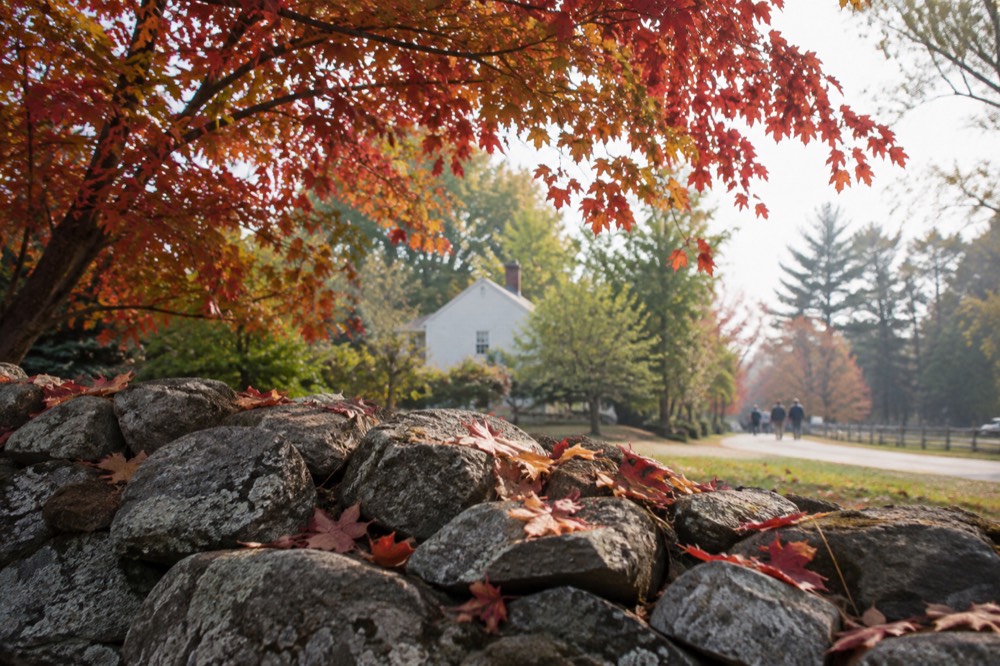
Spring through fall is the practical window, with April around Patriots’ Day carrying the annual reenactment commemorations and October drawing the foliage crowds. NOAA's climate normals for Boston show July as the warmest month at an 82.1 °F average high, and September at 73.1 °F with 3.56 inches of rain, so midsummer days are warm and autumn days are mild. Boston has no wet season and no dry season, with every month between 3.21 and 4.30 inches of precipitation, so rain planning matters more than rain avoidance.
The reenactment of the Lexington engagement each April is the towns' biggest event, and it draws crowds well beyond a normal weekend. Fall is the other peak, and the site's fall foliage day trips page covers the wider region. Winter visits are possible, the outdoor ground stays open, but the house museums' hours contract and the days are short.
| Season | Conditions (NOAA Boston normals) | Fit For The Trip |
|---|---|---|
| Spring | April high 56.4 °F, 3.63 in precipitation | Reenactment events in April around Patriots’ Day, muddy trails early |
| Summer | July high 82.1 °F, 3.27 in precipitation | Full hours at all sites, Walden Pond swimming |
| Fall | October high 62.1 °F, 4.03 in precipitation | Foliage crowds, mild walking weather |
| Winter | January high 36.8 °F, 14.3 in snow | Open ground, contracted museum hours |
What Does A Realistic One-Day Plan Look Like?
A workable driving day runs Lexington in the morning, the Battle Road trail at midday, and Concord in the afternoon, following the broad outbound order of the events of April 19, 1775. Arrive at Lexington Green early, before tour groups thicken, then drive the Battle Road stretch west with a stop at one of the park's trailheads, and finish at the North Bridge and Concord center before the house museums close. Walden Pond fits only if the museum interiors are skipped, or on a longer day.
The order matters less than the timing. The house museums in both towns close in the late afternoon, and the outdoor ground does not, so the safest structure is interiors early, open ground late. A rainy forecast flips the plan toward the museums; the site's rainy day in Boston guide covers the city-side alternatives if the whole region turns wet.
| Time | Stop | Notes |
|---|---|---|
| Morning, early | Lexington Green and Buckman Tavern | Beat the tour groups; check tavern hours |
| Mid-morning | Battle Road trail, Minute Man NHP | Pick one trailhead, walk a section |
| Midday | Lunch in Concord center | Cafés cluster around the main street |
| Early afternoon | North Bridge and Old Manse | Park grounds open sunrise to sunset |
| Late afternoon | Concord Museum or Walden Pond | Choose one; museum hours close first |
Visitors pairing this trip with a longer Boston stay can slot it into a one day in Boston plan as the second or third day, or use the 3-day Boston itinerary as the frame. Salem is the region's other history heavyweight, and the Salem day trip guide covers it.
Common Questions About Concord And Lexington Day Trips
how do you plan a concord ma day trip from boston?
Pick one town as your anchor, drive or book a guided tour, and structure the day around the house museums' closing hours. Lexington Green, the Battle Road trail, and the North Bridge are the three anchors, and the outdoor ground costs nothing. Check each museum's own page for hours before you commit to an itinerary.
Can you do both Concord and Lexington in one day?
Yes, by car or on a guided tour that covers both. The towns sit close together, and the Battle Road stretch of Minute Man National Historical Park connects them. A transit-only day usually forces a choice between the two, since the park land between them is spread out.
Is Minute Man National Historical Park free?
The outdoor ground, including the North Bridge area and the Battle Road trail, charges no admission fee. The park's historic houses and visitor facilities keep their own hours and programs, and the National Park Service's hours-and-fees page for Minute Man National Historical Park is the authoritative source.
What is the best month to visit Lexington and Concord?
April around Patriots’ Day carries the annual reenactment commemorations, and October draws foliage crowds. NOAA's Boston normals show October with a 62.1 °F average high, mild for walking. Every month of the year carries between 3.21 and 4.30 inches of precipitation, so no month is reliably dry; plan for rain year-round.
Do you need a car for a Concord day trip?
A car or a guided tour is the practical choice. The MBTA's commuter rail serves the region's rail-served towns at one-way fares from $2.40 to $13.25 by zone, but the sites that anchor the day are spread across two towns and national park land, which favors wheels.
How does this trip connect to Boston's Freedom Trail?
The Freedom Trail covers the Boston half of the Revolutionary story, and many outdoor stops are free, while several historic interiors charge admission. Lexington and Concord are where the military story began, so the trail and the battle towns read as one narrative in two places.
Choose Where Your Battle-Towns Trip Begins
These options do not match your choice. Adjust the selection or reset to explore the starting recommendation.
Compare Your Lexington And Concord Day Totals
Reader-entered estimates in USD, not live quotes. Use the same dates and travelers for both options. Include all relevant tickets, rooms, taxes, mandatory fees and transport for the entire trip once in each total. Do not add a transfer twice if your rate already includes it.
Lexington And Concord Day Tour From Boston
A 7–8-hour guided minibus outing with four fixed Boston pickup points, Lexington Battle Green, Battle Road, North Bridge and Concord Museum admission. Harvard, MIT and literary houses are pass-by sights, not interior visits. Lunch and tips are extra. Confirm the dated route and pickup time.
A starting option to explore. Choose dates, travelers and the exact booking option with the provider; availability and eligibility are confirmed there.
Check Lexington and Concord day tour dates