Is Candlepin Bowling A Boston Thing?
Candlepin bowling was invented in New England and remains a distinctly regional game. Here is what it is, where it came from, and where to play it in Boston.
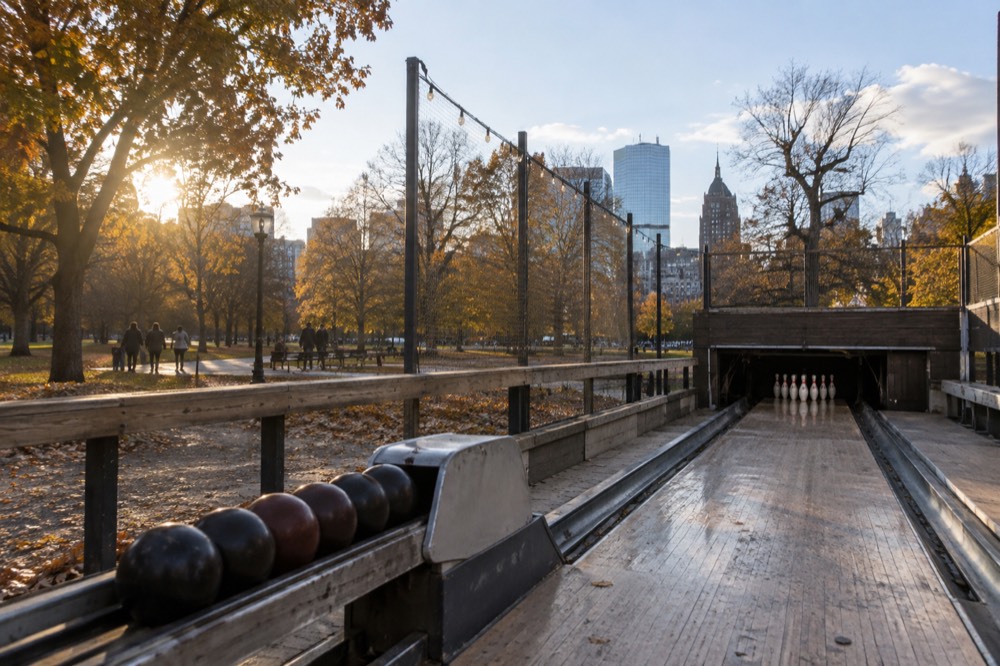
Is Candlepin Bowling A Boston Thing?
Bowling in most of the United States means tenpin: heavy balls, thick pins, two rolls per frame. Travel anywhere in New England and the rules quietly change. Candlepin bowling uses tall, slim pins that stay where they fall, small balls light enough for a child to loft with one hand, and three rolls per frame instead of two. The game was invented in Massachusetts and has never really spread beyond the region, which is exactly why visitors encounter it here and almost nowhere else. So yes, it is a Boston thing, in the way clam chowder and dropped R's are Boston things: a regional signature that locals take for granted and everyone else finds exotic.
What Is Candlepin Bowling?
Candlepin bowling is a New England variant of bowling played with tall, narrow pins, small handheld balls, and three rolls per frame, and unlike tenpin, fallen pins are not cleared between rolls, so deadwood becomes part of the strategy. The pins are slender enough to be hard to hit cleanly, and the balls have no finger holes, which makes spares genuinely difficult and high scores rare even for skilled players.
The differences sound small on paper and change everything in practice. In tenpin, a machine sweeps away fallen pins after your first roll, so each shot is a clean slate. In candlepin, the pins you knock down stay on the lane, and your second and third rolls have to work around, or through, the tangle of wood already lying there. A well-placed deadwood shot can knock standing pins sideways into each other, which is a legitimate and much-practiced technique. Locals call the piles of fallen wood "deadwood" and treat them as targets rather than obstacles, and the mental shift from avoiding them to using them is the moment the game clicks for most visitors.
Candlepin balls have no finger holes and are much smaller than tenpin balls. Roll them along the lane rather than treating “lofting” as an instruction. Ask staff about technique and lane rules; beginners’ progress and scores vary, and no first-game performance is guaranteed.
Where Did Candlepin Bowling Come From?
Candlepin bowling was invented in Massachusetts in the nineteenth century, in Worcester rather than Boston, and it has stayed overwhelmingly a New England game ever since, with only scattered pockets of play elsewhere in North America and the Canadian Maritimes. So it is not a Boston invention by birth, but it is a New England one, and Boston has been one of its strongholds for well over a century.
The game's regional identity is the point. It was designed as a version of bowling that children and adults could play together, using lighter equipment than the tenpin lanes of the era. That family framing stuck: candlepin houses in the Boston area have long run youth leagues, birthday parties, and casual "cosmic" nights alongside serious league play. The Maritimes connection matters too, since the Canadian provinces bordering New England adopted the game early and still play it, which is why a visitor from Halifax finds Boston's lanes familiar while a visitor from Chicago finds them alien.
For decades, candlepin was also a broadcast sport here. Televised candlepin matches were a fixture of New England regional television, with local bowlers becoming minor celebrities, and the game's slow, tactical pace translated surprisingly well to the screen. That television era cemented the game's place in the regional imagination, and reruns of old matches still circulate among nostalgic fans. It is hard to overstate how local all of this is: ask about candlepin outside the Northeast and most Americans will not know the word.
Candlepin is one of several things that make the region feel distinct, alongside the food and the accent. If you are building a broader picture of the city, our pieces on what Boston is most famous for and on fun activities to do in Boston cover the better-known half of that list.
Where Can You Play Candlepin Bowling Around Boston?
Candlepin is available at actual Boston-area venues, including Southie Bowl at 543 East Broadway in South Boston. Check the venue’s current hours, lane booking and shoe terms before traveling; league play can affect availability. Go City currently lists a one-hour Southie Bowl inclusion for eligible pass holders, subject to an available lane; that does not make buying a full pass good value for bowling alone.
The honest planning note is that Boston proper has fewer candlepin houses than it once did. Real estate pressure and the sport's regional decline have closed historic lanes over the decades, and the remaining ones tend to be beloved, slightly scruffy institutions with decades of league history on their walls. That is part of the appeal. A candlepin house feels like a time capsule in a way a modern tenpin megaplex never does, and the regulars are usually delighted to explain the deadwood rules to a first-timer. Other pages covering the same trip are gathered on Boston Travel Guide.
Getting to a suburban lane is straightforward on the T. The MBTA's fare table lists a subway one-way at $2.40 and a local bus at $1.70, and since the September 2026 fare changes riders can make unlimited transfers within a two-hour window, paying only the highest-priced leg, using the same payment method: the MBTA's fare page has the full details. A bus or subway ride plus a short walk covers most of the lanes in the city's inner suburbs, and the contactless Tap to Ride option means you do not need to sort out fare media before you go.
Here is how the two games compare at a glance:
| Feature | Candlepin | Tenpin |
|---|---|---|
| Rolls per frame | 3 | 2 |
| Ball | Small, no finger holes | Large, three finger holes |
| Pins | Tall, slim, light | Thick, heavier |
| Deadwood | Stays on the lane between rolls | Cleared after first roll |
| Where it is common | New England and the Canadian Maritimes | Everywhere in the US |
| Typical scoring | Low even for good players | Much higher ceilings |
And here is how a candlepin outing tends to break down for a visitor:
| Planning Item | What to Expect |
|---|---|
| Best nights for casual play | Weeknights, before league slots |
| Weekend lanes | Busy, reserve or arrive early |
| Learning curve | First frame feels odd, third frame feels natural |
| Group suitability | Works well for mixed ages, kids included |
| Atmosphere | Old-school, local, unfussy |
Is Candlepin Worth Adding To A Boston Itinerary?
Candlepin is worth an evening if you want something genuinely local that most visitors never do, especially on a rainy or cold night when outdoor sightseeing is off the table, but it is a garnish rather than a main course: budget one to two hours at a lane, and pair it with dinner in the same neighborhood rather than building a day around it.
Think of it as the same category as catching a local broadcast phrase or eating a regional candy: not the reason you came, but the thing you remember. Boston's headline attractions, from the Freedom Trail to Fenway Park, fill the daytime. Candlepin fills the gap after dinner, when the museums have closed and the weather has turned. Boston's weather also cooperates with this plan more often than visitors expect: the NOAA climate normals for the city show every month of the year carrying between roughly three and a quarter and four and a third inches of precipitation, so there is no dry season to plan around and an indoor fallback is always worth having in your pocket.
If that framing suits your trip, our one day Boston itinerary and our guide to what not to miss handle the daytime load, leaving your evening free for the lanes.
For a fuller sense of the city's character, the main things to do in Boston page covers the classics, and a candlepin night slots neatly into any of those plans as the after-dark half of the day.
Why Hasn't Candlepin Spread Beyond New England?
Candlepin never left New England because its economics and culture are tied to the region: the equipment, the lane setups, and the league traditions all grew up locally, tenpin had already claimed the national market and its standardized machinery, and the game's difficulty makes it a hard sell to casual players who grew up on tenpin's forgiving, high-scoring format.
The result is a game that functions as a regional shibboleth. Mention candlepin to a New Englander and you get a story, usually involving a grandparent, a childhood birthday party, or a televised match. Mention it to anyone from outside the region and you get a blank look followed by genuine curiosity. That combination, hyper-local loyalty and universal novelty, is precisely what makes it a good thing for a visitor to try: you cannot replicate this particular evening anywhere else in the country.
It also fits a pattern in Boston culture of holding onto older, slower pleasures. This is a city that still argues about which bakery makes the proper cannoli and where to find the best lobster roll, and candlepin belongs to that same instinct for the un-modernized. The lanes that survive do so because regulars kept showing up, not because anyone modernized the experience. That is either the charm or the limitation, depending on your taste, and both readings are fair.
Common Questions About Candlepin Bowling In Boston
Is candlepin bowling a Boston thing?
It is a New England thing that Boston shares. The game was invented in Massachusetts, it is played almost nowhere else in the country, and Boston has been one of its enduring strongholds, so visitors reasonably read it as a Boston signature even though the city did not invent it.
Is candlepin harder than regular bowling?
Yes, noticeably. The pins are slim and the balls are small with no finger holes, fallen pins stay on the lane as deadwood, and scores run far lower than tenpin players expect. Most first-timers improve quickly after the first frame or two.
Do kids fit a candlepin outing?
Very well. The balls were designed to be light enough for children, and the game's inventors intended it as a family activity. Most surviving candlepin houses run youth leagues and birthday parties.
Can you find candlepin lanes outside New England?
Only in scattered pockets. The game's real strongholds are the New England states and the Canadian Maritimes. Elsewhere in the United States, tenpin is effectively the only game in town.
How long does a candlepin game take?
Roughly the same as a tenpin game, so plan on about an hour for one game with a small group, longer if the house is busy or you play multiple strings as locals often do.