What Led To The 1773 Boston Tea Party?
Britain began taxing the American colonies directly to pay down debt from the French and Indian War, and Parliament insisted it had the right to legislate for the colonies even though the colonies elected no members of Parliament.
What Led To The 1773 Boston Tea Party?
On the night of December 16, 1773, a crowd of Bostonians boarded three merchant ships at Griffin's Wharf and dumped the East India Company's tea into the harbor. The act took roughly three hours and cost the company a fortune, but it was not a protest that began that evening. It was the closing move in a decade-long dispute over Parliament's right to tax colonies that had no vote in it, and every step along the way had been played out in Boston's newspapers, town meetings, and streets. The Freedom Trail Foundation traces the route through "over 250 years" of that history, and 16 of its sites sit inside the story, per the Foundation's own visit page.
Want to explore the Tea Party through a guided recreation? Compare museum entry with a separate downtown history walk. The museum is on Fort Point Channel, not a surviving 1773 wharf. Check Tea Party museum entry times
Why Was Britain Taxing The Colonies After The French And Indian War?
Britain began taxing the American colonies directly to pay down debt from the French and Indian War, and Parliament insisted it had the right to legislate for the colonies even though the colonies elected no members of Parliament. The Sugar Act and then the Stamp Act hit printers, lawyers, and merchants first, and Boston's merchant class responded with boycotts, pamphlets, and the argument of no taxation without representation.
The Stamp Act was repealed after colonial boycotts bit into British trade, but Parliament paired the repeal with the Declaratory Act, a flat assertion that it could bind the colonies "in all cases whatsoever." That pairing set the pattern for the next several years: a tax, a protest, a partial retreat, and a restatement of the principle at stake. Boston's merchants had learned that organized economic pressure worked, and the town's political leaders had learned how to mobilize a crowd.
The Townshend Acts restarted the fight with duties on glass, paint, paper, and tea. Boston responded again with boycotts, and customs enforcement turned violent. British troops occupied the town, and in March 1770 soldiers fired on a hostile crowd outside the Old State House, killing five civilians in what Boston's printers immediately named the Boston Massacre. The National Park Service maintains the Old State House among the fee-charging Freedom Trail sites, and its hours and fees page lists the admission details for visitors who want to stand at the corner where it happened.
What Was The Tea Act Of 1773?
The Tea Act of 1773 did not add a new tax on tea. The Townshend tea duty already existed, and colonists had been paying it, or dodging it, for years. What the Tea Act did was grant the struggling East India Company a monopoly on the legal American tea market and let it sell directly through its own agents, undercutting colonial merchants and smugglers alike. Boston saw the cheap tea as bait: accept it, and you accept Parliament's right to tax you.
That distinction is the part most retellings flatten. The outrage in Boston was not primarily about the price of tea, which was about to fall. It was that cheap legal tea would seduce ordinary colonists into paying the surviving Townshend duty on a mass scale, quietly conceding the constitutional point that Boston's leaders had spent years contesting. If the tea landed and sold, the boycott economy and the political argument both collapsed at once.
The East India Company shipped tea to four ports. New York and Philadelphia forced their consignees to resign and the ships turned back. Charleston stored its tea in a damp cellar rather than let it sell. Boston was different: its consignees, two of them relatives of Governor Thomas Hutchinson, refused to resign, and the governor refused to let the ships leave without first paying the duty.
| Step | What Happened | Why It Mattered |
|---|---|---|
| Sugar Act | Duty on molasses, enforced by customs officers | First revenue tax aimed squarely at colonial trade |
| Stamp Act | Tax on printed paper and legal documents | United merchants, printers, and lawyers in boycott |
| Townshend Acts | Duties on glass, paint, paper, and tea | Renewed boycotts; British troops sent to Boston |
| Boston Massacre | Soldiers kill five civilians outside the Old State House | Most Townshend duties repealed, except the duty on tea |
| Tea Act | East India Company monopoly on legal American tea | Cheap tea designed to make the surviving duty normal |
| Tea Party | Tea destroyed at Griffin's Wharf, December 16, 1773 | Parliament closes Boston's port; war follows in 1775 |
How Did Boston Escalate Before December 16?
Through November and early December 1773, Boston's town meetings demanded that the tea consignees resign and that the ships depart unloaded, while crowds kept the consignees from landing the cargo. The Dartmouth arrived in late November, the Eleanor and the Beaver followed, and a standoff ran for twenty days because customs law required a ship to unload within twenty days or be seized, and the governor would not grant clearance for a ship carrying untaxed-out tea to sail home.
The mathematics of the deadline made the confrontation inevitable. Once the twenty-day clock on the Dartmouth ran out on December 16, the customs service could legally seize the ship and its cargo, and seized tea could be landed and sold under official protection. The meeting at the Old South Meeting House that day was one of the largest Boston had ever held, and when word arrived that the governor still refused a pass, Samuel Adams is recorded as declaring the meeting could do nothing more for the country. Within hours, men in roughly disguised dress were at the wharf.
The mob that night was disciplined rather than chaotic, at least by the standards of a crowd destroying property. Witnesses described quiet, methodical work: chests hoisted on deck, split open, and emptied into the water, with the tea stirred down into the mud so it could not be recovered. Participants were sworn to secrecy, and it took years for the full story to surface publicly.
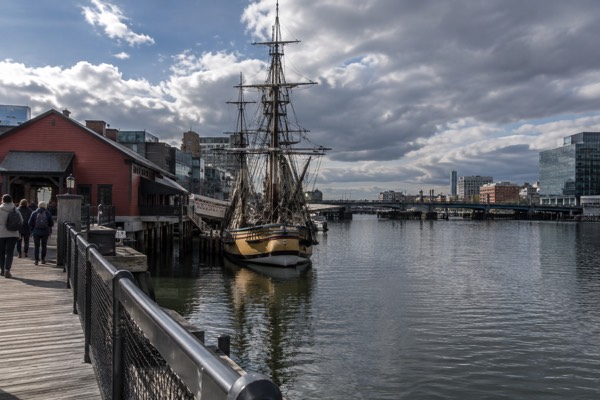
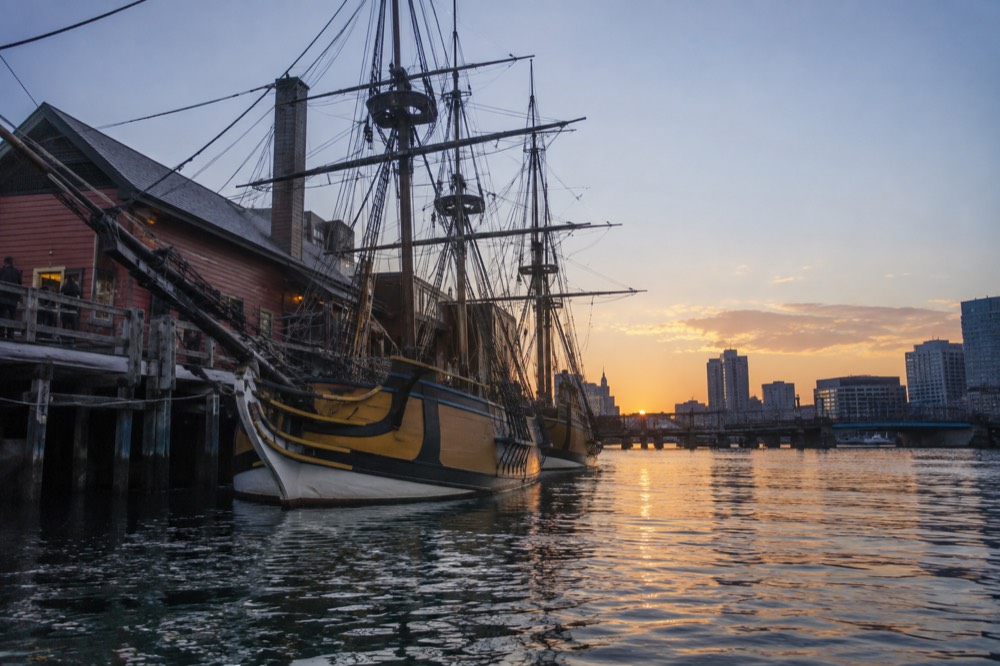
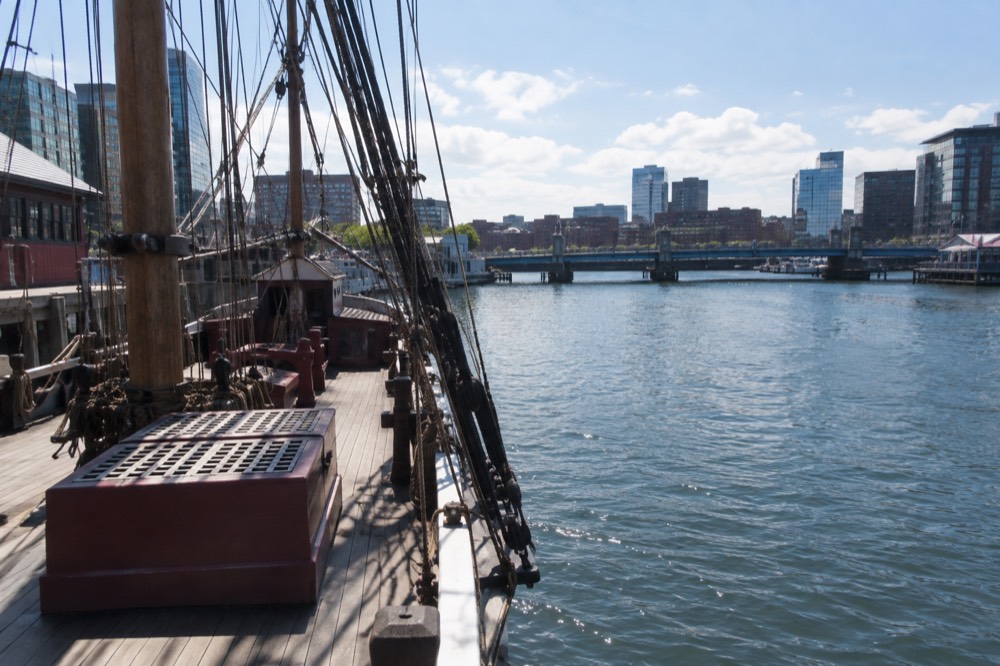
The modern Boston Tea Party Ships and Museum interprets the event on Fort Point Channel. It is not a surviving Griffin’s Wharf or the original ships; shoreline changes separate today’s museum experience from the historic site.
What Happened At Griffin's Wharf On The Night Itself?
On the evening of December 16, 1773, a body of men disguised as Mohawk Indians, estimates of their number range from a few dozen to over a hundred, boarded the Dartmouth, Eleanor, and Beaver at Griffin's Wharf, opened the tea chests, and emptied them into Boston Harbor over about three hours. No one was killed, no cargo other than tea was touched, and the participants reportedly swept the decks clean before leaving.
The restraint was the message. The destruction was narrowly aimed at the tea, the single commodity that carried the contested duty, and the crowd reportedly punished a participant caught pocketing tea for himself. Boston's leadership wanted the act read as a principled refusal, not a riot, and the discipline on the wharf was part of the argument. One of the original tea chests recovered from the harbor that night survives and is displayed today at the museum on Fort Point Channel, near the approximate historic waterfront area. Other pages covering the same trip are gathered on Boston Travel Guide.
What Did The Tea Party Lead To?
Parliament responded with the Coercive Acts in 1774, closing Boston’s port and curtailing Massachusetts self-government. The Quartering Act expanded authorities’ ability to lodge troops, including in unoccupied buildings; it should not be described as a general requirement to house soldiers in occupied private homes. Colonial resistance led to the First Continental Congress, followed by fighting at Lexington and Concord inApril1775.
The speed of that escalation is what makes the Tea Party the hinge point. In December 1773 the dispute was still about taxes and constitutional rights. By April 1775 it was a war, and the road ran directly through the Coercive Acts and the colonial response to them. Boston's port closure was the first time Parliament had used economic strangulation against an entire colonial town, and the other colonies read it as a preview of what awaited any of them.
| Party | Position in 1773 | What They Wanted |
|---|---|---|
| Parliament and the Crown | Asserted full authority to tax and legislate | Payment for the tea and acknowledgment of its right to rule |
| East India Company | State-backed trading giant with surplus tea | A legal American market to rescue its finances |
| Governor Thomas Hutchinson | Royal governor of Massachusetts | The tea landed and duty paid, upholding parliamentary authority |
| Boston's merchant and political leaders | Boycott organizers and town meeting leadership | The tea returned to England, unsold and undutied |
| The consignees | Handpicked company agents, two of them Hutchinson relatives | To sell the tea and take their commission |
Where Can You See This History In Boston Today?
The main stop is the Boston Tea Party Ships and Museum on Fort Point Channel at the Congress Street Bridge, where replicas of the Beaver and Eleanor are moored and one of the original tea chests is on display. The Old South Meeting House, where the December 16 meeting was held, is a Freedom Trail site that charges admission, and the Old State House, steps from the Massacre site, is reachable on the same combined ticket, according to the National Park Service's published fee schedule.
The Freedom Trail connects most of the locations in this story with a red line through downtown, and the National Park Service operates free sites along it, including Faneuil Hall, where the town meetings of the protest years were held. Four of the sixteen Trail sites charge admission and twelve do not, a split the NPS publishes on its own hours page. Visitors deciding how much time all of this needs can read how many days is enough to visit Boston, and anyone planning a first trip around the revolutionary sites can start with where to go in Boston for the first time.
Want the full story with a guide in person? Book a Revolutionary Boston walking tour here.
Check the downtown history walk’s route before combining it with the Tea Party museum. The walk’s guiding fee does not include museum admission or paid interiors along the trail. Check Freedom Trail walk dates
Common Questions About The Boston Tea Party
What led to the 1773 Boston Tea Party?
A decade of disputes over Parliament's right to tax the colonies without giving them representation, ending in the Tea Act of 1773, which gave the East India Company a monopoly on legal American tea and threatened to normalize the surviving Townshend tea duty. When Boston's consignees refused to resign and Governor Hutchinson refused to let the ships leave, the twenty-day customs deadline forced the confrontation on December 16.
Was the Boston Tea Party about the price of tea?
No. The Tea Act of 1773 actually made legal tea cheaper by cutting out colonial middlemen. The protest was about accepting the principle behind the tax: buying the cheap tea meant paying the duty, and paying the duty meant conceding that Parliament could tax the colonies without their consent.
Who participated in the Boston Tea Party?
Estimates of the number of men who boarded the ships that night range from a few dozen to over a hundred. They disguised themselves as Mohawk Indians, worked for about three hours, destroyed only the tea, and swore one another to secrecy. Names surfaced gradually over the following years.
How much tea was destroyed?
The East India Company's entire cargo aboard the Dartmouth, Eleanor, and Beaver went into Boston Harbor on the night of December 16, 1773. The work took roughly three hours, and the crowd reportedly stirred the tea into the water so that none of it could be recovered.
What happened to Boston afterward?
Parliament passed the Coercive Acts in 1774, closing Boston's port and curtailing Massachusetts self-government. The punishment united the colonies, led to the First Continental Congress, and the Revolutionary War began at Lexington and Concord in April 1775.
Choose How To Explore Tea Party History
These options do not match your choice. Adjust the selection or reset to explore the starting recommendation.
Compare Your History Visit Totals
Reader-entered estimates in USD, not live quotes. Use the same dates and travelers for both options. Include all relevant tickets, rooms, taxes, mandatory fees and transport for the entire trip once in each total. Do not add a transfer twice if your rate already includes it.
Boston Tea Party Ships And Museum
An approximately one-hour interactive guided museum and replica-ship experience. Check in at least 15 minutes before your tour. Closed on Thanksgiving and Christmas Day; other private-event closures can apply. Tea-room access does not mean refreshments are included.
A starting option to explore. Choose dates, travelers and the exact booking option with the provider; availability and eligibility are confirmed there.
Check Tea Party museum entry times